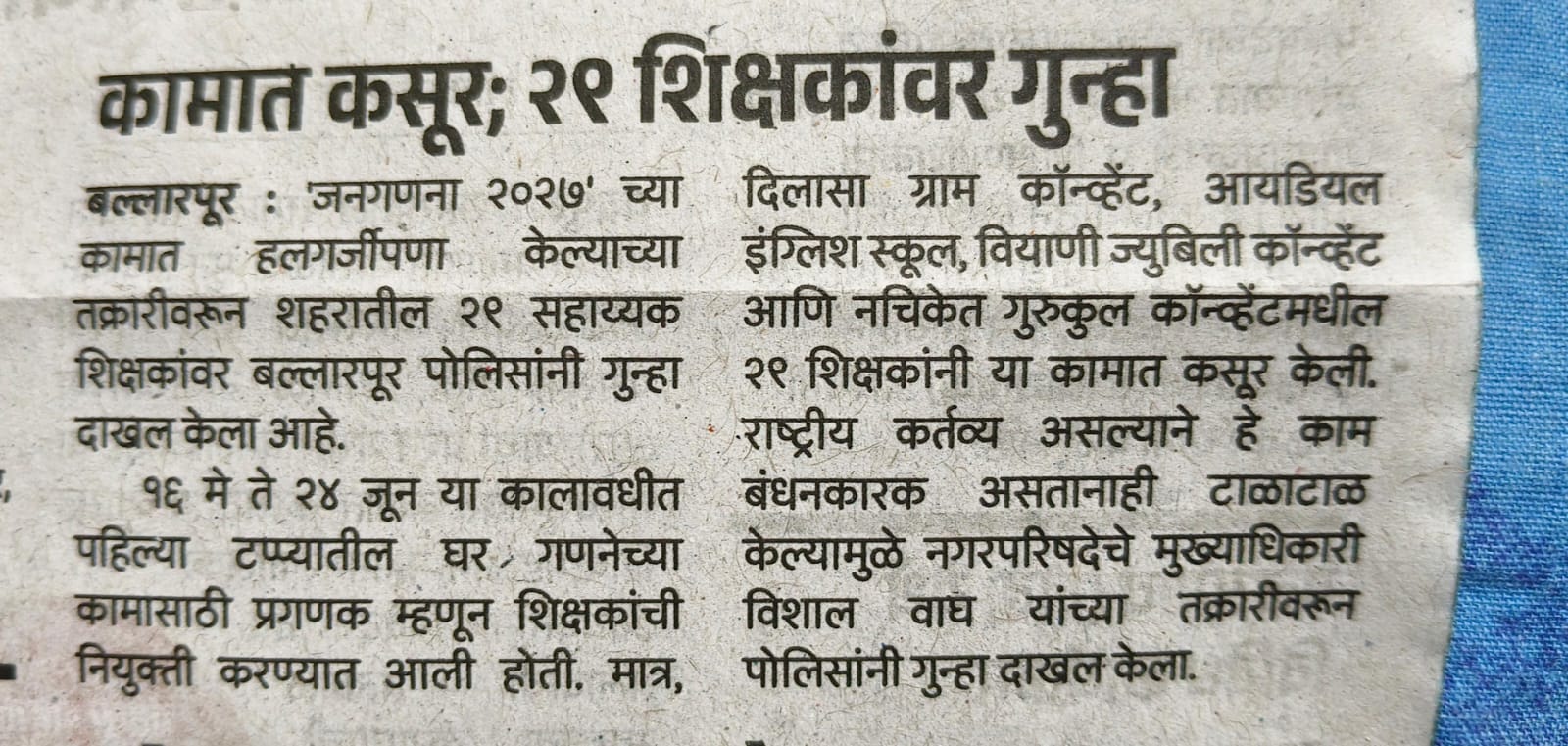
The controversy surrounding criminal action initiated against teachers for alleged negligence in census-related duties has now widened beyond Ballarpur, with reports indicating that a similar case is also learned to have been initiated in Chandrapur against nearly 16 teachers under provisions of the Census Act, 1948.
The developments have triggered intense legal discussion across Chandrapur district regarding the legality of the proceedings, the procedural safeguards applicable in such matters, and most importantly, whether the repeated public use of the term “FIR” is legally justified in offences that are classified as non-cognizable.
The issue first surfaced after Municipal Council Ballarpur issued a public press note stating that criminal cases had been registered against 29 teachers who were allegedly negligent in performing duties connected with “Census 2027” operations.
The press note referred specifically to Section 11(1)(A) of the Census Act, 1948 and stated that police action had been initiated at Ballarpur Police Station. Soon afterward, local media reports carried headlines suggesting that FIRs had been lodged against teachers for failing to perform census duties.
Now, with similar information emerging from Chandrapur regarding action against approximately 16 teachers, legal experts say the matter has become an important question of criminal procedure and administrative accountability.
Core Legal Question: Can an FIR Be Registered?
According to legal practitioners examining the issue, the central question is not whether the administration can take action against employees for negligence, but whether the law actually permits the police to register a regular FIR in such cases.
Section 11(1)(A) of the Census Act provides punishment for refusal or neglect in performing census duties. However, the punishment prescribed under the section is only a fine extending up to ₹1000.
Because the provision carries only monetary punishment and no imprisonment, criminal law experts state that the offence falls under the category of:
- Non-cognizable offences
- Bailable offences
Under criminal procedure, the distinction between cognizable and non-cognizable offences is crucial.
In cognizable offences, police may directly register an FIR, investigate the matter, and exercise wider powers under law.
However, in non-cognizable offences, police ordinarily cannot proceed with investigation without obtaining permission from the Magistrate. In such cases, the usual legal process begins with a non-cognizable complaint or station diary entry rather than a regular FIR in the conventional sense.
This is why the repeated public use of the word “FIR” in relation to the teachers’ cases has become legally controversial.
“Use of the Word FIR May Not Be Legally Appropriate”
Several advocates from Chandrapur district have opined that using the expression “FIR registered” in a matter involving a purely non-cognizable offence may not be legally accurate unless additional cognizable sections are involved.
According to legal observers, the terminology used by authorities carries significant consequences because ordinary citizens often interpret the word “FIR” as indicating serious criminal wrongdoing.
Legal observers point out that indiscriminate use of criminal terminology may unintentionally stigmatize teachers and create fear within the educational community.
Some lawyers further argue that even if police have accepted a complaint, describing it publicly as a conventional FIR without clarifying the procedural limitations applicable to non-cognizable offences may amount to a misleading presentation of the legal position.
Teachers Fear Damage to Reputation
The controversy has deeply affected the teaching community in Ballarpur and Chandrapur.
Teachers privately say that media reports using phrases such as “FIR against teachers” or “criminal case registered” create social embarrassment and damage professional reputation, especially when parents and students begin perceiving educators as accused persons in serious criminal proceedings.
Several teachers stated that while they respect government responsibilities and public duties, the use of criminal law language against educators over administrative assignments has caused anxiety and mental distress.
School managements are also reportedly seeking legal advice regarding the rights available to institutions and staff members in such situations.
Can Authorities Be Challenged for Misleading Communication?
Legal experts say affected teachers or educational institutions may consider legal remedies if they believe the administration or officials issued communications that created fear disproportionate to the actual legal position.
Possible legal actions may include:
- Seeking official clarification from authorities
- Demanding withdrawal or correction of misleading press notes
- Issuing legal notices for reputational harm
- Filing complaints before higher administrative authorities
- Challenging procedural irregularities before competent courts
- Approaching the High Court if due process has allegedly been violated
Advocates note that while government authorities certainly possess powers to ensure compliance with lawful duties, those powers must be exercised within the framework established by criminal procedure.
“National Duty Cannot Override Legal Procedure”
Most legal experts agree that census work is a matter of public importance and that appointed personnel are expected to cooperate with lawful instructions. However, they stress that administrative convenience cannot override statutory safeguards guaranteed under criminal law.
Legal analysts also point out that public authorities must avoid language that creates panic or presents a legally exaggerated picture before society.
Wider Debate Emerging in District
The Ballarpur and Chandrapur developments have now sparked wider debate within educational and legal circles regarding the increasing tendency to invoke criminal proceedings in administrative matters.
Some observers believe stronger communication and coordination with teachers would have been more effective than publicly announcing criminal action. Others maintain that public servants must take government assignments seriously and comply within prescribed timelines.
However, the principal legal debate continues to revolve around one crucial issue: whether the term “FIR” was properly and legally used in matters involving offences that are, by nature, non-cognizable.
As discussions intensify, many teachers and institutions are now waiting for formal clarification from authorities regarding the exact procedural status of the cases and whether all legal requirements under criminal law were properly followed.
Legal Analyst & Advocate
For ChandrapurLawyer.com