Trusted Legal Guidance

At Adv. Nazim Khan Legal Chambers, we offer trusted expertise in criminal, civil, and family law.Our criminal law practice ensures strong defense and protection of your rights.
In civil matters, we provide clear strategies for resolving disputes effectively.With family law, we guide you through sensitive issues with care and professionalism.We are committed to delivering reliable legal solutions with integrity at every step.

Our Services

Dedicated to delivering justice, fairness, and peace of mind in every case.

Criminal Law

With proven expertise in criminal law, we handle complex cases with precision. From defense to appeals, we safeguard your freedom at every step.

Family Law

Our family law services cover divorce, custody, maintenance, adoption, and domestic disputes with legal solutions that prioritize fairness, dignity, and peace of mind.

Property Law

Our property law services cover registration, documentation, and litigation. We provide clear guidance to ensure your property matters are handled with confidence.

Consumer Rights

Our consumer rights services address complaints, disputes, and grievances. We stand by you to ensure honesty, fairness, and accountability in every case.

Trusted Clients
+
Case Studies
18.
Total Cases Won
16. +
Success Rate
99. %

Dedicated Team of Attorneys

Sed cursus ante dapibus diam sed nisi nulla quis

Chris Smith

Civil Rights Law

Nulla quis sem at nibh elementum imperdiet. Duis sagittis ipsum. Praesent mauris fusce nec.

Jada Dawson

Commercial Law

Nulla quis sem at nibh elementum imperdiet. Duis sagittis ipsum. Praesent mauris fusce nec.

William Gibbs

Corporate Law

Nulla quis sem at nibh elementum imperdiet. Duis sagittis ipsum. Praesent mauris fusce nec.

Rosa Parks

Criminal Law

Nulla quis sem at nibh elementum imperdiet. Duis sagittis ipsum. Praesent mauris fusce nec.

Are you A law graduate? apply for an internship with us

Step into the world of practical law with our internship opportunities. Gain skills, mentorship, and confidence for your future.

Let's win your case

We believe every case deserves dedicated attention and a winning strategy. With our proven legal expertise, we fight for your rights and deliver results you can trust.

Why Choose Our Legal Services

We combine experience, strategy, and dedication to secure the best outcomes.

Experienced Legal Professionals

Our skilled lawyers bring years of expertise across criminal, family, property, and consumer law, ensuring you receive strong representation.

Best Case Strategies

We analyze every detail to craft the strongest legal strategy, tailored to your unique situation for the best possible outcome.

With You - From Start to Finish

From your first consultation to the final resolution, we stand by your side, guiding you with transparency, care, and commitment.


Testimonials

Real stories of trust, justice, and successful outcomes.

The team guided me through my property dispute with clarity and confidence. Thanks to their support, I was able to resolve the case smoothly. Truly the best legal help in Chandrapur!
Ramesh K.
Chandrapur
I was struggling with a family matter, but their lawyers handled everything with professionalism and compassion. They really stood by me throughout. Highly recommend them for anyone in the surrounding areas.
Anita S
Ballarpur
From the first consultation itself, I felt reassured. They explained the legal process in simple terms and fought for my rights until the end. Reliable legal service in Chandrapur you can trust.
Vivek M
Warora

Request a Free Consultation

Take the first step toward justice with a confidential consultation.

Our Blog

Learn about general law and public awareness
January 19, 2026By Adv. M. N. Khan, Chandrapur Introduction: Transparency Meets Procedural Discipline The Right to Information Act, 2005 is widely regarded as one of India’s most powerful democratic legislations. It empowers citizens to demand accountability from public authorities and strengthens participatory governance. However, as the law matures, courts and commissions continue to define its boundaries. A recent decision of the Central Information Commission (CIC), holding that advocates cannot invoke the RTI Act on behalf of their clients in relation to pending or connected litigation, has triggered intense discussion within legal circles.“Can a lawyer, acting as a legal representative, use the RTI Act as a tool to gather information for a client’s case?”The CIC has answered this in the negative — and in doing so, has reshaped an important aspect of legal practice. The Core Issue Before the Commission The case before the CIC involved an advocate who filed an RTI application seeking information from a public authority concerning a contractual dispute. The application was expressly stated to be on behalf of the client. When the information was denied, the matter reached the Commission in second appeal. The Commission rejected the appeal and laid down a clear principle:“The RTI Act cannot be converted into a mechanism for conducting litigation or advancing professional legal practice.”Citizenship Versus Professional Capacity The Commission acknowledged that an advocate is undoubtedly a citizen. However, it emphasised that the capacity in which the information is sought is crucial. When an RTI application is filed purely to advance a client’s litigation, the character of the RTI request changes. The CIC observed:“The client himself is competent to seek information under the RTI Act. The advocate cannot act as a proxy to invoke the Act for litigation purposes.”RTI Is Not a Parallel Litigation Tool The Commission cautioned that allowing advocates to routinely file RTI applications for their clients would create a parallel system of discovery outside courts.“RTI cannot be permitted to bypass established judicial procedures of evidence, discovery, and inspection.”Courts already provide mechanisms such as discovery, interrogatories, summons, and judicial directions. RTI cannot replace these processes. Judicial Support for the CIC View The Commission relied on High Court precedents which consistently hold that RTI should not be used to obtain information relating to matters sub judice in order to gain litigation advantage.“RTI is a transparency law, not a litigation strategy.”Doctrinal Justification Litigation is governed by special procedural statutes such as the Code of Civil Procedure, Code of Criminal Procedure, and tribunal rules. These special laws override general mechanisms like RTI when the subject matter is litigation-related. Administrative and Institutional Concerns If advocates are allowed to use RTI as a litigation tool, public authorities would face tactical filings, administrative burdens, and delays for genuine transparency seekers. Addressing the Criticism The ruling does not curtail the client’s right. The client remains free to file an RTI application personally. What is restricted is only the professional proxy use.“The right under RTI is a democratic entitlement of the citizen, not a transferable professional instrument.”RTI Is Not a Law of Agency The RTI Act does not function on principles of agency. It is not designed to operate like a power of attorney. The right is personal to the citizen. Ethical Dimensions Using RTI to secure information that would otherwise require judicial permission raises ethical concerns and may prejudice the opposing party. Protection of Sub Judice Proceedings RTI authorities are not equipped to balance disclosure with trial fairness. Courts alone possess the institutional competence to decide what should be disclosed during litigation. Not a Blanket Ban on Advocates An advocate may still file RTI applications in personal capacity or in public interest. The restriction applies only when the RTI is connected to a client’s case. Guidance for Litigants RTI is not a substitute for procedural remedies in court. Discovery applications, summons, and judicial directions remain the appropriate routes. Lessons for Young Advocates“The strength of advocacy lies not in shortcuts, but in mastery of lawful procedure.”Preserving the Democratic Character of RTI If RTI were perceived as a litigation weapon for lawyers, its legitimacy as a citizen’s transparency tool would suffer. Conclusion The CIC’s ruling protects the citizen-centric character of RTI, upholds procedural integrity in litigation, and reinforces ethical advocacy.“The rule of law thrives not on exploitation of loopholes, but on respect for institutional balance.”The RTI Act remains a powerful instrument of transparency. Its effectiveness depends on responsible use by citizens and principled restraint by professionals. Disclaimer The present article and accompanying infographic are intended solely for academic, informational, and public awareness purposes. They do not constitute legal advice, legal opinion, or professional solicitation. The views expressed herein are personal to the author, based on a reading of the Right to Information Act, 2005, and reported decisions of the Central Information Commission and courts as available in the public domain. Readers are advised to independently verify the law and consult a qualified legal professional before relying upon or acting on the contents of this publication. By Adv. M. N. Khan, Chandrapur Introduction: Transparency Meets Procedural Discipline The Right to Information Act, 2005 is widely regarded as one of India’s most powerful democratic legislations. It empowers citizens to demand accountability from public authorities and strengthens participatory governance. However, as the law matures, courts and commissions continue to define its boundaries. A recent decision of the Central Information Commission (CIC), holding that advocates cannot invoke the RTI Act on behalf of their clients in relation to pending or connected litigation, has triggered intense discussion within legal circles.“Can a lawyer, acting as a legal representative, use the RTI Act as a tool to gather information for a client’s case?”The CIC has answered this in the negative — and in doing so, has reshaped an important aspect of legal practice. The Core Issue Before the Commission The case before the CIC involved an advocate who filed an RTI application seeking information from a public authority concerning a contractual dispute. The application was expressly stated to be on behalf of the client. When the information was denied, the matter reached the Commission in second appeal. The Commission rejected the appeal and laid down a clear principle:“The RTI Act cannot be converted into a mechanism for conducting litigation or advancing professional legal practice.”Citizenship Versus Professional Capacity The Commission acknowledged that an advocate is undoubtedly a citizen. However, it emphasised that the capacity in which the information is sought is crucial. When an RTI application is filed purely to advance a client’s litigation, the character of the RTI request changes. The CIC observed:“The client himself is competent to seek information under the RTI Act. The advocate cannot act as a proxy to invoke the Act for litigation purposes.”RTI Is Not a Parallel Litigation Tool The Commission cautioned that allowing advocates to routinely file RTI applications for their clients would create a parallel system of discovery outside courts.“RTI cannot be permitted to bypass established judicial procedures of evidence, discovery, and inspection.”Courts already provide mechanisms such as discovery, interrogatories, summons, and judicial directions. RTI cannot replace these processes. Judicial Support for the CIC View The Commission relied on High Court precedents which consistently hold that RTI should not be used to obtain information relating to matters sub judice in order to gain litigation advantage.“RTI is a transparency law, not a litigation strategy.”Doctrinal Justification Litigation is governed by special procedural statutes such as the Code of Civil Procedure, Code of Criminal Procedure, and tribunal rules. These special laws override general mechanisms like RTI when the subject matter is litigation-related. Administrative and Institutional Concerns If advocates are allowed to use RTI as a litigation tool, public authorities would face tactical filings, administrative burdens, and delays for genuine transparency seekers. Addressing the Criticism The ruling does not curtail the client’s right. The client remains free to file an RTI application personally. What is restricted is only the professional proxy use.“The right under RTI is a democratic entitlement of the citizen, not a transferable professional instrument.”RTI Is Not a Law of Agency The RTI Act does not function on principles of agency. It is not designed to operate like a power of attorney. The right is personal to the citizen. Ethical Dimensions Using RTI to secure information that would otherwise require judicial permission raises ethical concerns and may prejudice the opposing party. Protection of Sub Judice Proceedings RTI authorities are not equipped to balance disclosure with trial fairness. Courts alone possess the institutional competence to decide what should be disclosed during litigation. Not a Blanket Ban on Advocates An advocate may still file RTI applications in personal capacity or in public interest. The restriction applies only when the RTI is connected to a client’s case. Guidance for Litigants RTI is not a substitute for procedural remedies in court. Discovery applications, summons, and judicial directions remain the appropriate routes. Lessons for Young Advocates“The strength of advocacy lies not in shortcuts, but in mastery of lawful procedure.”Preserving the Democratic Character of RTI If RTI were perceived as a litigation weapon for lawyers, its legitimacy as a citizen’s transparency tool would suffer. Conclusion The CIC’s ruling protects the citizen-centric character of RTI, upholds procedural integrity in litigation, and reinforces ethical advocacy.“The rule of law thrives not on exploitation of loopholes, but on respect for institutional balance.”The RTI Act remains a powerful instrument of transparency. Its effectiveness depends on responsible use by citizens and principled restraint by professionals. Disclaimer The present article and accompanying infographic are intended solely for academic, informational, and public awareness purposes. They do not constitute legal advice, legal opinion, or professional solicitation. The views expressed herein are personal to the author, based on a reading of the Right to Information Act, 2005, and reported decisions of the Central Information Commission and courts as available in the public domain. Readers are advised to independently verify the law and consult a qualified legal professional before relying upon or acting on the contents of this publication. Read more...
January 19, 2026A LiveLaw-Style Analysis of Madarsa Ahle Sunnat Imam Ahmad Raza v. State of Uttar Pradesh, Writ-C No. 307 of 2026Introduction: When Regulation Becomes Suppression Can the State shut down an educational institution merely because it lacks formal recognition, even when the law prescribes no such consequence? This constitutional question lay at the heart of Writ-C No. 307 of 2026, decided by the High Court of Judicature at Allahabad, Lucknow Bench. The Court decisively held that non-recognition of a Madarsa does not, by itself, justify its closure. In an era where regulatory oversight of minority institutions increasingly intersects with constitutional freedoms, the judgment delivered by Hon’ble Justice Subhash Vidyarthi assumes particular significance. It reasserts a foundational principle of administrative law.“What the statute does not expressly permit, the executive cannot enforce by implication.”Factual Matrix: Closure Order Triggered by Non-Recognition The petitioner, C/M Madarsa Ahle Sunnat Imam Ahmad Raza, through its Manager Abdul Rahman, challenged an order dated 01 May 2025 passed by the District Minority Welfare Officer, Shrawasti. The impugned order directed the Madarsa to close its operations solely on the ground that it was functioning without recognition under the Uttar Pradesh Madarsa regulatory framework. The Madarsa did not dispute its unrecognised status. Instead, it raised a fundamental legal question: Does lack of recognition empower the State to order closure of an educational institution?Arguments Before the Court Petitioner’s Submissions The petitioner relied upon Regulation 13 of the Uttar Pradesh Non-Governmental Arabic and Persian Madarsa Recognition, Administration and Services Regulation, 2016, contending that:The only consequence of non-recognition is denial of grant-in-aid. The Regulations do not provide for closure. The Madarsa was not seeking any financial assistance. The closure order was ultra vires and illegal.State’s Stand The State defended the action by arguing that recognition is essential for lawful functioning. However, no statutory provision authorising closure was cited.Judicial Reasoning: Regulation Cannot Travel Beyond the Statute The Court observed that:The Regulations distinguish recognition from entitlement to benefits. Regulation 13 only denies grant-in-aid. No authority exists to shut down an unrecognised Madarsa.“Executive authorities cannot impose consequences that the statute itself does not prescribe.”Accordingly, the closure order was held illegal.The Constitutional Undercurrent: Article 30 Madarsas enjoy protection under Article 30(1) of the Constitution. Regulation must be reasonable and must not destroy the core right of minorities to administer their institutions. A closure order without statutory authority would violate this constitutional protection.Regulation vs Prohibition The Court reaffirmed that recognition regulates privileges, whereas closure amounts to prohibition, which requires legislative sanction.Why This Judgment Matters This ruling affects:Private unaided schools Minority colleges Vocational and religious institutionsNon-recognition alone cannot be used as a weapon to shut down institutions.Administrative Overreach Checked The judgment reminds authorities that administrative convenience cannot override statutory limits. Regulation must remain within legal boundaries.Final OutcomeClosure order dated 01.05.2025 was quashed. The Madarsa was allowed to continue functioning. Non-recognition was held to affect only grant entitlement.Conclusion: Rule of Law Over Regulatory Anxiety“Non-recognition is not a death warrant.”Unless the legislature clearly mandates closure, administrative authorities cannot invent penalties by executive action. This judgment restores constitutional balance, statutory discipline, and the supremacy of the rule of law.Editorial Note – ChandrapurLawyer.com This decision is likely to be cited in future challenges against arbitrary closure orders across India. Legal practitioners dealing with education law, minority rights, and administrative law should closely follow its application. Read more...
January 8, 2026“The court is not a place for unruly behaviour. Discipline is the soul of the justice delivery system.”This observation of the Supreme Court of India reflects a concern that goes beyond any single case. It speaks to a growing problem inside Indian courtrooms.Indian courts are built on tradition, hierarchy, and mutual respect. From district courts to High Courts and the Supreme Court, the legal profession has always placed strong emphasis on decorum. Lawyers are not merely representatives of clients. They are officers of the court, entrusted with the responsibility of assisting judges in the administration of justice.Yet, in recent years, Indian courts have repeatedly expressed concern over declining courtroom discipline. One worrying aspect of this decline is the increasing instances of poor conduct by junior lawyers toward senior members of the Bar. This behaviour, if left unchecked, risks damaging the credibility of India’s justice system.Respect as the Foundation of Indian Legal PracticeIn India, the relationship between senior and junior lawyers has traditionally been one of mentorship. Seniors guide juniors not only in law, but also in courtroom behaviour, ethics, and professional limits. This tradition helped maintain order even in crowded and overburdened courts.The Supreme Court, in Mahipal Singh Rana v. State of Uttar Pradesh (2016), stressed that legal ethics and professional standards are essential to preserve public confidence in courts. The Court noted that lawyers play a key role in shaping how justice is perceived by society. When lawyers fail in discipline, the entire system suffers.Respect toward senior lawyers is not about submission. It is about recognising experience and preserving institutional discipline. Senior advocates have spent decades understanding Indian procedural law, judicial temperament, and courtroom culture. Their conduct sets examples for younger members of the Bar.Growing Judicial Concern Over Courtroom MisconductIndian courts have not remained silent on this issue. In R.K. Anand v. Registrar, Delhi High Court (2009), the Supreme Court highlighted the importance of integrity and dignity in the legal profession. The Court observed that misconduct by lawyers directly affects the administration of justice and public trust.Several High Courts have also raised alarms. The Delhi High Court, while dealing with incidents of courtroom disruption, has remarked that aggressive and disrespectful conduct by lawyers creates chaos and delays justice. The Court warned that courts cannot become arenas for personal dominance or unchecked behaviour.In another instance, the Bombay High Court observed that junior lawyers must learn restraint and courtroom discipline early in their careers. The Court emphasised that confidence must not cross into arrogance.Confidence Versus Arrogance in Indian CourtsIndia’s legal profession is highly competitive. Young lawyers face immense pressure due to limited opportunities, delayed briefs, and financial insecurity. Ambition is natural in such an environment. However, courts have made it clear that ambition must be balanced with humility.In Harish Uppal v. Union of India (2003), the Supreme Court emphasised that lawyers must uphold the dignity of courts and cannot resort to conduct that disrupts proceedings. Raising one’s voice or showing aggression does not strengthen an argument.Unfortunately, some junior lawyers believe that interrupting seniors or confronting them publicly will establish authority. In Indian court culture, such behaviour has the opposite effect. Judges notice it immediately. Seniors remember it. Reputations suffer quietly but permanently.Impact on Judges and Court FunctioningIndian courts already function under extreme pressure. Heavy caseloads, limited time, and administrative challenges require lawyers to assist rather than obstruct proceedings. When junior lawyers engage in disrespectful conduct, judges are forced to intervene unnecessarily.The Madras High Court once observed that courts should not be reduced to spaces where judges act as disciplinarians instead of adjudicators. Time spent controlling behaviour is time taken away from delivering justice.This loss affects litigants directly. Delays increase. Hearings are disrupted. The seriousness of the judicial process is diluted.Loss of Public Faith in the Justice SystemFor many Indians, court proceedings are intimidating. Litigants enter courts with hope, fear, and uncertainty. They expect lawyers to act with professionalism and dignity. When they witness open disrespect between lawyers, their faith weakens.In O.P. Sharma v. High Court of Punjab and Haryana (2011), the Supreme Court stated that professional misconduct by advocates erodes the image of the judiciary itself.When clients see junior lawyers disrespecting seniors, they begin to believe that success in court depends on power struggles rather than legal merit. This belief harms the moral authority of Indian courts.Seniors as Custodians of Legal CultureSenior lawyers in India are more than legal experts. They are carriers of legal culture. They understand unwritten courtroom norms, judicial temperament, and professional boundaries. Juniors learn these aspects not from law books, but from observation.Disrespect disrupts this learning chain. When seniors withdraw mentorship due to poor conduct, juniors lose valuable guidance. Over time, this weakens the collective strength of the Bar.The Supreme Court has noted that the legal profession survives on continuity. Values must pass from one generation to the next. Without respect, this continuity breaks.Responsibility of Bar Associations and InstitutionsIndian Bar Councils and Bar Associations have a duty to address declining professional conduct. Ethics cannot remain theoretical. They must be enforced through guidance, counselling, and discipline.In Mahipal Singh Rana, the Supreme Court made it clear that silence in the face of misconduct is not neutrality—it is neglect.Senior lawyers also carry responsibility. Correction must be firm but fair. The aim should always be improvement, not humiliation.A Choice That Shapes the Future of Indian JusticeJunior lawyers represent the future of India’s justice system. Their conduct today will define public trust tomorrow. Respect does not weaken independence. It strengthens credibility.The majesty of law lies not only in judgments, but also in the conduct of those who practice it. This truth applies most strongly inside courtrooms.If Indian lawyers choose patience over ego and learning over confrontation, the justice system will grow stronger. If disrespect becomes routine, the damage will be slow but deep.India’s courts have survived because of discipline, tradition, and mutual respect. Preserving these values is essential. Respect for senior lawyers is, in essence, respect for the law itself. Without it, justice becomes fragile. Read more...
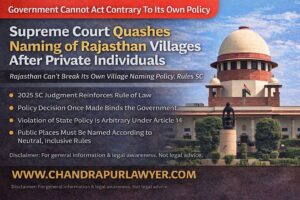
December 26, 2025Court: Supreme Court of India Bench: Justice Sanjay Kumar & Justice Alok Aradhe Decision Date: December 2025 Subject: Administrative Law | Government Policy | Article 14 | Public Governance Platform: ChandrapurLawyer.com Authored By: Adv. Mohammad Nazim Khan Advocate & Legal Researcher Introduction: When Policy Becomes a Binding Promise In a landmark ruling reinforcing the rule of law in governance, the Supreme Court of India has held that a government cannot act contrary to its own declared policy. Any such action, the Court held, is arbitrary, unconstitutional, and liable to be struck down. The Court quashed the Rajasthan Government’s decision to name certain revenue villages after private individuals, holding that the action violated a binding State policy that expressly prohibited naming villages after individuals, castes, religions, or communities. This judgment is not merely about village names. It is a far-reaching pronouncement on administrative discipline, constitutional equality, and the limits of executive discretion. Why This Judgment MattersCurbs arbitrary government action Reinforces policy consistency Strengthens Article 14 (Equality before Law) Prevents misuse of power under personal or political influence Affirms that government policies are binding, not optionalFactual Background: How the Dispute Arose Creation of New Revenue Villages In December 2020, the Government of Rajasthan issued a notification under Section 16 of the Rajasthan Land Revenue Act, 1956, creating several new revenue villages in Barmer district. Among them were villages named Amargarh and Sagatsar, named after private individuals who had donated land for village formation. Why the Naming Was ChallengedThe State had a binding policy dated 20 August 2009 The policy prohibited naming villages after individuals Such naming violated constitutional equality It encouraged personal glorification in public governanceThe 2009 Rajasthan Government Policy The core dispute revolved around a government circular dated 20 August 2009, which laid down that revenue villages shall not be named after individuals, caste, sub-caste, religion, or community. The policy aimed to ensure neutrality, inclusiveness, and avoidance of state-sponsored personal glorification. Conflicting High Court Decisions Single Judge of Rajasthan High Court The Single Judge quashed the naming, holding that the policy was binding and the government’s action violated Article 14. Division Bench Reverses the Order The Division Bench later reversed the decision, holding that the policy was directory and that the State had discretion under the Land Revenue Act. Key Legal Question Before the Supreme Court Can a government act in violation of its own declared policy without amending or withdrawing it? Supreme Court’s Analysis: Policy Is Not a Suggestion 1. Government Policy Has Binding Force The Supreme Court categorically held that once a policy is framed and notified, the Government is bound by it. Policies govern executive conduct unless lawfully modified. 2. Government Cannot Pick and Choose Selective application of policy violates Article 14, encourages arbitrariness, and undermines public trust. 3. Violation of Policy Equals Arbitrary Action Acting contrary to policy without amendment is inherently arbitrary. Arbitrariness, the Court reiterated, is the antithesis of equality. 4. Policy Must Be Amended, Not Ignored If the Government intended to permit naming villages after individuals, it was required to formally amend the 2009 policy and apply it uniformly. Ignoring policy without amendment is Final impermissible. Article 14: Equality as the Constitutional Backbone Public naming affects collective identity. Unequal or selective naming creates preferential treatment and lacks rational classification, violating equality before law. Public Land, Public Identity The Supreme Court emphasised that public entities must reflect public character, not private recognition. Naming villages after individuals blurs public-private boundaries and encourages patronage. Final OutcomeDivision Bench judgment set aside Single Judge’s order restored Naming of villages after individuals quashedWider Legal Principles ReaffirmedExecutive must act within self-imposed limits Rule of law prevails over executive convenience Public power is a trust held for the peopleWhy This Judgment Has National Significance The ruling impacts naming of public places, administrative discretion, and judicial review of policy violations across India. Explainer: When Can Government Deviate from Policy?Policy must be formally amended Change must be notified Reasonable justification must exist Change must apply uniformlyConclusion: Policy Is a Promise, Not a Preference By holding that the government cannot act contrary to its own policy, the Supreme Court has strengthened rule of law, curtailed arbitrariness, and reinforced administrative accountability. In a democracy, government policy is not optional. It is a binding promise to the people. Disclaimer: This article is published on ChandrapurLawyer.com for general legal awareness and informational purposes only. It does not constitute legal advice. Readers are advised to consult qualified legal professionals for advice specific to their facts and circumstances. The views expressed are personal to the author. Read more...
December 26, 2025Court: Gujarat High Court Case Title: Ranjana Mulchandbhai Shitlani vs Gujarat Housing Board & Ors. Citation: 2025:GUJHC:69694 Decision Year: 2025 Subject: Property Law | Adverse Possession | Public Authority Land Platform: ChandrapurLawyer.com Authored By: Adv. Mohammad Nazim Khan Advocate & Legal Researcher Introduction: A Common Belief, Firmly Rejected by Law In a significant judgment reaffirming settled principles of property law, the Gujarat High Court has categorically held that long or continuous possession of land does not, by itself, create ownership rights, particularly when the land belongs to a statutory or public authority. The ruling came in Ranjana Mulchandbhai Shitlani vs Gujarat Housing Board & Ors. (2025:GUJHC:69694), where the petitioner claimed ownership and protection against eviction primarily on the ground of long-standing possession. Rejecting the plea, the High Court ruled that possession without legal title remains possession only and cannot mature into ownership unless strict legal requirements—such as adverse possession—are conclusively proved. Background of the Dispute The petitioner challenged actions initiated by the Gujarat Housing Board, a statutory authority, claiming long, peaceful, and uninterrupted possession of the disputed land.Continuous possession for several decades Open and uninterrupted occupation Claim for protection against evictionThe Housing Board countered that the land was public property and that the petitioner had no document of title, allotment, lease, or sale deed. Core Legal Issue Before the Court Does long possession of land, without valid title, create ownership or enforceable rights against the lawful owner, particularly a public authority? Understanding the Difference: Possession vs Ownership The Court reiterated the fundamental distinction between possession and ownership.Possession – physical control over property Ownership – legal title conferring rights to use, enjoy, transfer, and excludeConfusing possession with ownership, the Court observed, leads to serious legal errors. Petitioner’s ArgumentsLong duration of possession should create rights Earlier inaction by the authority implied acquiescence Equitable relief due to hardship Implied entitlement from long occupationStand of the Gujarat Housing BoardThe land is public property No title documents exist in petitioner’s favour The petitioner is an unauthorised occupant Equity cannot defeat statutory ownershipGujarat High Court’s Analysis and Findings 1. Long Possession Does Not Create Ownership The Court categorically held that long possession, however continuous, does not confer ownership unless it ripens into adverse possession in accordance with law. 2. Adverse Possession Is Not Automatic To succeed in adverse possession, a claimant must prove:Hostile possession against the true owner Open and notorious occupation Continuous possession for the statutory period Knowledge of the true ownerThe burden of proof lies entirely on the claimant, which was not discharged in this case. 3. No Easy Adverse Possession Against Public Authorities Claims against government or statutory bodies are scrutinised more strictly, as public land is held in trust for society. 4. Equity Cannot Override Law The Court rejected sympathy-based pleas, holding that equity follows the law and cannot legalise unauthorised occupation. 5. Delay by Authorities Does Not Confer Rights Mere delay or inaction by a public authority does not amount to transfer of ownership or creation of legal rights. Judgment OutcomePetition dismissed No ownership or possessory right recognised Authority of Gujarat Housing Board upheldWhy This Judgment Is ImportantReinforces rule of law in property disputes Protects public land from encroachments Dispels myths around long possession Restricts misuse of writ jurisdictionImpact on Future Property Litigation The ruling will significantly influence disputes involving encroachments, adverse possession claims, and challenges against housing boards and development authorities. Conclusion: Possession Without Title Is a Weak Shield The Gujarat High Court’s ruling is a timely reminder that ownership flows from law, not occupation. Possession may offer limited protection in rare cases, but it cannot replace legal title, especially against public authorities. Disclaimer: This article is published on ChandrapurLawyer.com for general legal awareness and informational purposes only. It does not constitute legal advice or create a lawyer-client relationship. Readers are advised to consult a qualified legal professional before acting on the information. The views expressed are personal to the author. Read more...
December 26, 2025Court: Madras High Court Case Title: The Government of India v. S. Somasundaram & Others Case No.: Writ Appeal No. 806 of 2022 Category: Legal News | Constitutional & Administrative Law | Pension Schemes Platform: ChandrapurLawyer.com Authored By: Adv. Mohammad Nazim Khan Founder – ChandrapurLawyer.com IntroductionIn an important judgment bringing clarity to the interpretation of freedom fighters’ pension schemes in India, the Madras High Court has categorically ruled that grant of pension under a State Freedom Fighters Pension Scheme does not automatically entitle a person to receive pension under the Central Government’s Swatantrata Sainik Samman Pension Scheme, 1980.The ruling was delivered in The Government of India v. S. Somasundaram & Others (WA No. 806 of 2022), where the Court drew a firm legal distinction between State-level welfare schemes and Central Government pension schemes, holding that both operate independently and are governed by separate eligibility criteria.The judgment settles a recurring legal issue that has resulted in multiple litigations across the country.Background of the CaseThe dispute arose when S. Somasundaram, already receiving pension under a State Government Freedom Fighters Pension Scheme, applied for pension under the Central Government’s Swatantrata Sainik Samman Pension Scheme, 1980.The Central Government rejected the claim on the ground that the applicant failed to satisfy the mandatory eligibility and documentary requirements prescribed under the Central scheme. It was emphasised that State recognition alone cannot automatically confer entitlement under the Central policy.Aggrieved, the claimant approached the Madras High Court. A Single Judge allowed the writ petition and directed the Central Government to extend pensionary benefits.Challenging this order, the Union of India filed a Writ Appeal before a Division Bench, leading to the present judgment.Key Legal Issue Before the CourtWhether receipt of pension under a State Freedom Fighters Pension Scheme automatically entitles a person to pension under the Central Swatantrata Sainik Samman Pension Scheme, 1980, and whether courts can compel grant of pension without strict compliance with Central scheme conditions.Findings of the Madras High Court 1. State and Central Pension Schemes Are DistinctThe Court held that State and Central Freedom Fighters Pension Schemes are separate and independent welfare schemes, framed under different authorities, funded from different exchequers, and governed by different rules.Eligibility under one scheme cannot be automatically imported into another.2. Central Pension Requires Independent ComplianceThe Swatantrata Sainik Samman Pension Scheme, 1980 prescribes specific conditions relating to documentary proof, verification of participation in the freedom struggle, certifying authorities, and the period of suffering.These requirements must be independently satisfied, irrespective of State-level recognition.3. Single Judge’s Order Was UnsustainableThe Division Bench held that equating State pension eligibility with Central pension entitlement dilutes the statutory framework of the Central scheme and amounts to judicial overreach.Courts cannot rewrite or relax policy conditions on equitable considerations alone.4. Appeal Allowed, Liberty ReservedWhile allowing the appeal and setting aside the Single Judge’s order, the Court clarified that the claimant is not permanently barred from seeking Central pension. He may submit a fresh application strictly in accordance with Central scheme requirements.Where the Judgment Is ReportedLatestLaws.com – Article ID: 232663 LawStreet.co – Legal news summary SCC Online Blog – Legal news sectionLegal Significance of the JudgmentPrevents automatic Central pension claims based on State recognition Upholds policy autonomy of welfare schemes Reinforces limits on judicial intervention in policy matters Ensures financial discipline in public welfare administrationConclusionThe Madras High Court has decisively clarified that State and Central Freedom Fighters Pension Schemes operate in separate legal domains. While honouring freedom fighters remains a national duty, eligibility under welfare schemes must be determined strictly in accordance with governing rules.This judgment will serve as a guiding precedent for courts, administrators, and claimants across India and will help reduce unnecessary litigation arising from misconceptions about pension entitlements.Disclaimer: This article is published on ChandrapurLawyer.com for general legal awareness and informational purposes only. It does not constitute legal advice or legal opinion. Readers are advised to consult a qualified legal professional for advice specific to their facts and circumstances. The views expressed are personal to the author and do not represent the views of any court, authority, or institution. Read more...
December 26, 2025Delhi High Court Rejects Poverty Plea of Cheque Bounce ConvictAuthored By: Adv. Mohammad Nazim Khan Advocate & Legal Researcher Founder – ChandrapurLawyer.com Introduction: A Strong Message from the Delhi High CourtIn a decisive and strongly worded order, the Delhi High Court has reiterated that depositing compensation under Section 148 of the Negotiable Instruments Act, 1881 is the rule, not the exception. A convicted cheque bounce offender cannot escape this statutory obligation by merely pleading poverty, old age, or ill health.The ruling arose in a case where a 68-year-old convict sought to avoid depositing any amount out of ₹1.90 crore compensation. Rejecting the plea, the Court observed that the petitioner had “not deposited a single penny” and failed to demonstrate any exceptional circumstance.The judgment reinforces the legislative intent behind the 2018 amendment, aimed at preventing abuse of appellate remedies and ensuring victims are not deprived of compensation due to prolonged litigation.Background of the CaseThe case involved a serious financial transaction based on a forged Letter of Credit. On the strength of the forged document, the petitioner obtained substantial funds from a bank.When repayment was demanded, the petitioner issued a cheque, which was dishonoured for insufficiency of funds, resulting in prosecution under Section 138 NI Act.The Trial Court convicted the accused, sentencing him to one year’s imprisonment and directing payment of over ₹1.90 crore as compensation. The Appellate Court upheld the conviction.Seeking suspension of sentence without depositing any amount under Section 148, the convict approached the Delhi High Court.Arguments Raised by the ConvictClaim of financial poverty and inability to deposit compensation Plea of old age and health issues Argument that deposit under Section 148 is discretionary Assertion that deposit would infringe the right to appealUnderstanding Section 148 NI Act Why Section 148 Was IntroducedThe 2018 amendment sought to curb delay tactics adopted by convicted cheque bounce offenders, who often prolonged litigation without paying compensation.Purpose of the ProvisionDiscourage frivolous appeals Ensure partial restitution to victims Maintain credibility of cheque transactions Balance rights of accused and complainantsDelhi High Court’s Findings 1. Deposit Is the Rule, Not the ExceptionThe Court held that deposit under Section 148 is the norm. Waiver can be granted only in rare and exceptional circumstances, supported by cogent material.2. Financial Incapacity Is Not an Exceptional CircumstanceThe petitioner failed to produce credible financial documents or insolvency records. Mere claims of poverty were held insufficient.3. “Not Deposited a Single Penny” – Lack of Bona FidesThe Court noted that the petitioner enjoyed interim protection but showed no seriousness in complying with statutory obligations, demonstrating lack of bona fides.4. Legislative Intent Cannot Be DefeatedAllowing convicts to bypass deposit would defeat the purpose of Section 148 and undermine confidence in banking and commercial transactions.Relevant Judicial PrecedentsSurinder Singh Deswal v. Virender Gandhi (2019) Jamboo Bhandari v. State of Madhya Pradesh (2023) Consistent High Court rulings rejecting poverty as a ground for waiverWhy This Judgment MattersStrengthens financial accountability Protects victims of cheque dishonour Discourages delay tactics Enhances trust in judicial enforcementFrequently Asked Questions (FAQ) Q1. Is deposit mandatory for filing an appeal? No, but suspension of sentence generally requires compliance with Section 148. Q2. Can old age or illness exempt deposit? Only in rare, well-proved cases. Q3. What if the appeal succeeds? The deposited amount may be returned with interest. Q4. Does this apply across India? Binding in Delhi; persuasive elsewhere. ConclusionThe Delhi High Court’s ruling reaffirms that law cannot be diluted by sympathy alone. By holding that deposit under Section 148 NI Act is the rule, the Court has strengthened financial discipline and ensured that justice is not indefinitely delayed for victims.Disclaimer: This article is published on ChandrapurLawyer.com for general legal awareness only. It does not constitute legal advice. Readers are advised to consult a qualified advocate for advice specific to their circumstances. The author and publisher disclaim liability arising from reliance on this content. Read more...
December 25, 2025Punjab & Haryana High Court Sets Aside Order Allowing Validation of Photocopy Punjab & Haryana High Court Raman Wadhwa v. Satnam Singh & Others CR-5769-2025 (O&M) By Adv. M. N. Khan ChandrapurLawyer.com Introduction The Punjab and Haryana High Court, in Raman Wadhwa v. Satnam Singh & Others (CR-5769-2025), has delivered an important and clarificatory ruling on the law governing secondary evidence and stamp duty, particularly in cases where the original instrument is not available on record. The judgment revisits the inter-relationship between the Indian Stamp Act, 1899 and the Indian Evidence Act, 1872, and draws a clear boundary on the jurisdiction of trial courts while dealing with photocopies or partially original documents. Setting aside the Trial Court’s order, the High Court held that a copy of a document cannot be validated for stamp purposes and that permitting such validation amounts to exercise of jurisdiction not vested in law. Factual Background During the pendency of a civil trial, one of the parties sought permission to lead secondary evidence on the ground that the original instrument was not available. Along with this, permission was sought to validate a photostat copy for stamp duty purposes. The Trial Court allowed the application, holding that the party could lead secondary evidence and that the photocopy could be validated by payment of stamp duty and penalty. Aggrieved by this order, the opposing party approached the Punjab and Haryana High Court contending that the Trial Court had exceeded its statutory authority. Statutory Framework Considered Indian Stamp Act, 1899Section 33 – Power to examine and impound instruments Section 35 – Instruments not duly stamped inadmissible in evidence Section 36 – Admission of instrument where not to be questionedIndian Evidence Act, 1872Section 63 – Definition of secondary evidence Section 65 – Circumstances permitting secondary evidenceThe Court emphasised that while the Evidence Act governs the mode of proof, the Stamp Act governs admissibility. Issue for Determination Whether a Trial Court can validate a photocopy or a partially original document for stamp purposes and permit it to be used as secondary evidence when the original instrument is not available on record. Findings of the High Court Original Instrument Must Exist as a Whole The High Court held that an instrument must exist in its complete and original form for the purposes of the Stamp Act. A document that is partly original and partly photocopied cannot be treated as an original instrument in law. Composite or Partial Documents Cannot Be Treated as Originals Rejecting the Trial Court’s approach, the High Court clarified that a document is a single composite legal instrument. If it does not exist wholly in original form, it loses its legal character as an original. Copies Cannot Be Validated for Stamp Purposes A copy—whether partial or complete—cannot be validated for the purposes of stamping. Stamp duty is levied on execution of the original instrument. The Stamp Act does not contemplate validation or regularisation of photocopies. Evidence Act Does Not Override Stamp Act The Court drew a clear distinction between permission to lead secondary evidence and admissibility under the Stamp Act. Even if secondary evidence is otherwise permissible, an unstamped or insufficiently stamped instrument cannot be admitted, directly or indirectly. Trial Court Acted Without Jurisdiction The High Court held that the Trial Court had no jurisdiction to validate a photocopy for stamp purposes and had exercised powers not vested in it by law. Final DecisionRevision petition allowed Order of the Trial Court set aside Validation of photocopy for stamp duty held impermissibleLegal and Practical SignificanceReaffirms mandatory nature of stamp law Clarifies limits on use of secondary evidence Provides guidance to trial courts on jurisdictional boundariesConclusion The judgment in Raman Wadhwa v. Satnam Singh & Others serves as a timely reminder that procedural convenience cannot override statutory mandates. By holding that photocopies cannot be validated for stamp purposes and that trial courts lack jurisdiction to permit such validation, the High Court has reinforced evidentiary discipline in civil trials. Read more...
December 25, 2025Delhi High Court (Full Bench) ABC vs XYZ (2025: DHC: 11467 : FB) Introduction In a landmark judgment bringing much-needed clarity to matrimonial jurisprudence, the Full Bench of the Delhi High Court has held that one-year separation is not a mandatory pre-condition for granting divorce by mutual consent under Section 13B of the Hindu Marriage Act, 1955. The decision resolves long-standing confusion arising from divergent judicial interpretations and reaffirms that procedural timelines under Section 13B are directory, not mandatory, where the marriage has irretrievably broken down and consent is genuine. The ruling strengthens the evolving judicial approach that matrimonial law must be applied with pragmatism, compassion, and constitutional sensitivity rather than rigid technicality. Background: Section 13B and the Question of Separation Section 13B of the Hindu Marriage Act provides for divorce by mutual consent and was introduced recognising that forcing parties to remain in a broken marriage serves no social or legal purpose. Traditionally, Section 13B(1) requires that the parties:Have been living separately for a period of one year or more; Have not been able to live together; Have mutually agreed that the marriage should be dissolved.This is followed by a cooling-off period under Section 13B(2). Over time, courts differed on whether the one-year separation requirement was absolute or flexible. The Reference to the Full Bench Conflicting decisions by coordinate benches of the Delhi High Court created uncertainty on whether one-year separation was a jurisdictional requirement. Given the recurring nature of the issue, the matter was referred to a Full Bench for authoritative determination. Whether the requirement of one-year separation under Section 13B(1) is mandatory, or whether courts can grant divorce by mutual consent even before completion of such period. Facts in Brief In ABC vs XYZ, the parties soon realised that their marriage was unworkable. Despite attempts at reconciliation, the relationship deteriorated beyond repair. Both spouses voluntarily agreed to dissolve the marriage, settled all ancillary issues, and approached the Family Court seeking divorce by mutual consent. Objections arose solely on the ground that one year had not elapsed. Interpretation of “Living Separately” The Full Bench held that physical separation for a fixed period is not the sole indicator of marital breakdown.Parties may live under the same roof yet be matrimonially separated; Separation lies in cessation of marital obligations; Rigid timelines ignore lived realities of relationships.Legislative Intent Behind Section 13B Tracing legislative history, the Court noted that Section 13B was enacted to enable dignified exits from dead marriages, reduce bitterness, and promote amicable resolution. Directory vs Mandatory: Legal Analysis The Court reiterated that mandatory provisions invalidate proceedings upon non-compliance, while directory provisions permit discretion where no prejudice is caused.No penal consequence is prescribed for non-compliance with the one-year period; The provision is procedural in nature; Courts retain discretion to assess marital breakdown.Reliance on Supreme Court Precedents The Full Bench relied on progressive Supreme Court decisions including:Amardeep Singh v. Harveen Kaur (waiver of cooling-off period); Naveen Kohli v. Neelu Kohli (irretrievable breakdown); Shilpa Sailesh v. Varun Sreenivasan (constitutional autonomy).Constitutional Perspective Invoking Article 21, the Court held that dignity includes the right not to be trapped in a dysfunctional marriage. Procedural rigidity cannot override personal autonomy. Family Courts and Judicial Discretion Family Courts must examine whether consent is genuine, reconciliation has failed, and whether continuation of marriage serves any purpose. Mechanical application of timelines is discouraged. Safeguards Against MisuseAbsence of coercion or fraud; Complete settlement of disputes; Informed and voluntary consent.Impact on Matrimonial LitigationTimely relief to litigants in dead marriages; Reduction in prolonged litigation and emotional distress; Uniformity and clarity in application of law; Alignment with contemporary social realities.Ratio Decidendi The requirement of one-year separation under Section 13B(1) of the Hindu Marriage Act is directory and not mandatory, and courts may grant divorce by mutual consent even before completion of one year where the marriage has irretrievably broken down. Conclusion The Full Bench decision in ABC vs XYZ marks a significant milestone in Indian matrimonial jurisprudence. By prioritising dignity, autonomy, and justice over procedural rigidity, the Delhi High Court has reaffirmed that law must serve human realities. The judgment stands as a reminder that compassion is not antithetical to law; it is its highest expression. Read more...
December 25, 2025BIG NEWS: Supreme Court Issues Notice to Centre on Circumcision – No Final Ruling Yet Supreme Court of India Notice issued to Union of India under POCSO-related challenge Matter remains sub judice | No final adjudication Introduction: Separating Fact from MisinformationIn recent days, reports and social media discussions surrounding a Supreme Court proceeding concerning circumcision have generated widespread attention and, in some instances, misinformation. Headlines suggesting that the Supreme Court has banned circumcision or declared it illegal do not reflect the current legal position.What has actually occurred is that the Supreme Court of India has issued a notice to the Central Government in a matter raising questions regarding circumcision in the context of the Protection of Children from Sexual Offences Act, 2012 (POCSO Act).Importantly, no final judgment has been delivered, no declaration of illegality has been made, and no ban has been ordered. The matter is presently at a preliminary stage. What Exactly Has the Supreme Court Done?The Supreme Court has issued a notice to the Union of India. Issuance of notice is a procedural step through which the Court:Calls upon the concerned authority to respond to the issues raised; Seeks the official legal and policy position of the government; Ensures that all stakeholders are heard before adjudication.Issuance of notice does not amount to a ruling on merits. It neither confirms nor rejects the arguments raised in the petition. No Final Judgment, No Ban, No Change in LawThe Supreme Court has not declared circumcision illegal. No nationwide ban has been ordered. No change has been made to existing law. No directions have been issued to law-enforcement agencies.Any assertion to the contrary is premature and legally incorrect. Understanding Why the Issue Reached the Supreme CourtThe petition reportedly raises questions about how the POCSO Act, a stringent child-protection statute, interacts with practices that may be argued to have cultural, religious, or medical dimensions.At this stage, the Court has sought the Centre’s response to understand legislative intent, statutory scope, and whether any legal ambiguity requires interpretation. The Role of the POCSO ActThe POCSO Act was enacted to provide robust protection to children against sexual offences. Its provisions are wide, strict, and welfare-oriented.However, complex factual scenarios occasionally require courts to examine whether the law is being applied consistently with constitutional safeguards and legislative intent. Why the Centre’s Response Is CrucialThe Union of India’s reply will be pivotal. The Centre is expected to place before the Court:The statutory framework governing the issue; The legislative history and intent of relevant provisions; Any existing safeguards or recognised exceptions; The government’s position on balancing child protection and constitutional freedoms.Constitutional Dimensions Potentially InvolvedAlthough the matter is at a preliminary stage, it potentially engages constitutional principles such as:Article 21 – life, personal liberty, bodily integrity, and dignity; Article 14 – equality before law; Articles 25 and 26 – freedom of conscience and religious practice.Judicial Caution in Sensitive MattersThe Supreme Court has historically exercised restraint in matters involving religion, criminal law, and social practices. Courts typically prefer detailed hearings, expert input, and comparative analysis rather than summary conclusions. The Meaning of “Sub Judice”The matter is currently sub judice, meaning it is under judicial consideration. This implies that no final opinion has been formed and public discourse should not treat interim steps as conclusions. Addressing the Spread of MisinformationIssuance of notice is frequently misreported as a declaration of law. Such misunderstanding can cause unnecessary anxiety and distort public understanding of judicial processes. What Happens Next?Filing of a detailed response by the Central Government; Possible replies by the petitioners; Further hearings and judicial deliberation; Eventual adjudication on merits.Why No Interim Directions Were IssuedThe absence of interim orders itself indicates judicial restraint. Had the Court perceived immediate illegality, it could have issued directions. Instead, it chose measured examination. Conclusion: The Legal Position at PresentAs of now, the Supreme Court has merely issued notice to the Central Government. There is no ban, no declaration of illegality, and no change in law. The case remains pending and will be decided after hearing all sides.Until a final judgment is delivered, accuracy, restraint, and respect for due process must guide public discourse. Read more...
December 25, 2025No Section 65B Certificate, Yet Divorce Upheld: Madhya Pradesh High Court on Adultery, Electronic Evidence, and the Role of Family Courts Madhya Pradesh High Court Matrimonial Appeal – Adultery & Electronic Evidence Family Courts Act, 1984 | Evidence Act, 1872 IntroductionThe increasing use of digital devices in everyday life has transformed the nature of evidence presented before courts. Photographs, messages, call records, and electronic data now frequently form the backbone of disputes, particularly in matrimonial litigation.In a significant ruling, the Madhya Pradesh High Court upheld a decree of divorce granted on the ground of adultery, even though the photographs relied upon were not supported by a Section 65B certificate. The decision revisits the relationship between the Evidence Act, the Family Courts Act, and the realities of matrimonial adjudication.The judgment underscores a crucial principle: family law proceedings are not meant to be decided solely on technicalities, but on a holistic assessment of conduct, probabilities, and truth. Factual Background of the CaseThe marriage between the parties had broken down irretrievably. The husband approached the Family Court seeking divorce on the ground of adultery, alleging that the wife was involved in an extramarital relationship.To substantiate his claim, the husband relied upon photographs stored on a mobile phone, depicting the wife with another man in compromising circumstances. The Family Court, after appreciating the evidence, granted a decree of divorce.Aggrieved by this decision, the wife preferred an appeal before the Madhya Pradesh High Court, raising a primarily evidentiary challenge. The Wife’s Argument: Strict Application of Section 65BThe wife relied upon the Supreme Court’s judgment in Arjun Panditrao Khotkar v. Kailash Kushanrao Gorantyal, contending that electronic evidence produced without a Section 65B certificate is inadmissible.The photographs constituted electronic records. No Section 65B certificate accompanied them. The Family Court erred in relying on inadmissible material. The divorce decree was therefore legally unsustainable.The Central Legal QuestionWhether strict compliance with Section 65B of the Evidence Act is mandatory in matrimonial proceedings before Family Courts, and whether absence of such certificate automatically renders electronic evidence inadmissible. Family Courts Act: A Distinct Evidentiary RegimeThe High Court placed reliance on Section 14 of the Family Courts Act, 1984, which empowers Family Courts to receive evidence that may not be strictly admissible under the Evidence Act, provided it assists the court in effectively adjudicating the dispute.This provision reflects legislative intent that family disputes, deeply personal in nature, should not be defeated by rigid procedural rules. Why Matrimonial Proceedings Are DifferentMatrimonial disputes are decided on preponderance of probabilities. Courts examine conduct, surrounding circumstances, and human behaviour. The objective is to determine whether the marital bond has irretrievably broken down.Applying criminal trial standards to family disputes would defeat the very purpose of family law adjudication. Conduct of the Wife: A Crucial FactorThe Court noted that the wife did not deny her presence in the photographs. Her defence was limited to a vague allegation of manipulation, without explaining how, by whom, or for what purpose the photographs were altered.She further admitted that the photographs were originally stored on her own mobile phone. Such admissions carried substantial evidentiary weight in matrimonial proceedings. Breaking of the Mobile Phone: Context MattersThe argument that the husband broke the mobile phone to destroy evidence was rejected. The Court observed that human conduct in cases of marital discord must be assessed realistically.Preventing further communication in the context of alleged infidelity could not, by itself, justify drawing an adverse inference. Distinguishing Arjun PanditraoThe High Court clarified that the Supreme Court’s ruling in Arjun Panditrao was delivered in the context of strict evidentiary rules applicable to regular civil and criminal courts.Section 14 of the Family Courts Act was not overridden. The Family Courts Act is a special statute. Criminal trial standards cannot be mechanically imported into matrimonial disputes.Adultery: Proof and ProbabilityAdultery is rarely proved by direct evidence. Courts have consistently held that it may be inferred from circumstantial evidence, including conduct, association, and opportunity.In the present case, photographs, admissions, and surrounding circumstances cumulatively established a strong probability of an extramarital relationship. Broader Legal SignificanceReaffirms wide evidentiary discretion of Family Courts. Cautions against reliance on technical objections alone. Encourages holistic evaluation of digital evidence. Clarifies context-sensitive application of Section 65B.ConclusionThe Madhya Pradesh High Court’s decision reinforces the principle that law is a tool for justice, not a trap of technicalities. In matrimonial proceedings, substance must prevail over form and truth over procedure.By upholding the divorce despite the absence of a Section 65B certificate, the Court has reaffirmed a foundational principle of family law adjudication that will continue to guide Family Courts across the country. Read more...
December 25, 2025Punjab and Haryana High Court Holds Insurer Liable for Compensation Punjab and Haryana High Court National Insurance Company Limited v. Satbir and Others (2025: PHHC: 163083) IntroductionIn an important ruling with significant implications for motor accident compensation claims, the Punjab and Haryana High Court has held that a driver’s licence continues to remain valid for a period of 30 days after its expiry, and that during this interregnum period, the insurer cannot escape liability on the ground of an invalid driving licence.The judgment in National Insurance Company Limited v. Satbir and Others (2025: PHHC: 163083) reinforces the statutory protection afforded under the Motor Vehicles Act, 1988, and clarifies a recurring dispute raised by insurance companies in claim proceedings. Factual BackgroundThe case arose out of a motor accident claim where the offending vehicle was admittedly insured with the appellant, National Insurance Company Limited. The claimants sought compensation under the Motor Vehicles Act, alleging rash and negligent driving.The insurance company resisted liability on the ground that the driver’s driving licence had expired prior to the date of the accident, contending that the driver was not holding a valid and effective licence at the relevant time.The Motor Accident Claims Tribunal rejected this contention and fastened liability upon the insurer. Aggrieved, the insurance company approached the Punjab and Haryana High Court. Legal Issue Before the CourtWhether the insurer can avoid liability when the driving licence of the driver had expired shortly before the accident, but the accident occurred within 30 days of such expiry. Statutory FrameworkThe Court examined Section 15 of the Motor Vehicles Act, 1988, which governs renewal of driving licences. The provision stipulates that if an application for renewal is made within 30 days of expiry, the licence shall be renewed with effect from the date of its expiry.This statutory grace period ensures continuity of validity and prevents penal consequences arising from minor delays in renewal. Findings of the High CourtA driving licence does not become invalid immediately upon expiry. The statutory scheme provides a 30-day window during which the licence is deemed effective. If the accident occurs within this period, the driver cannot be treated as unlicensed. The defence raised did not constitute a fundamental breach of policy conditions.Rejection of Insurer’s DefenceThe Court observed that the insurer failed to establish that the driver was disqualified from holding a licence or that the licence had been revoked. Mere expiry, followed by renewal within the permissible period, does not defeat a third-party claim.The High Court reiterated that insurance defences must be interpreted strictly, particularly where third-party rights are involved. Significance of the JudgmentProtects accident victims from technical objections by insurers. Clarifies the legal position on licence expiry and renewal grace periods. Reinforces statutory protections over policy conditions. Discourages mechanical defences lacking proof of actual breach.Consistency with Established JurisprudenceThe judgment aligns with settled jurisprudence holding that the Motor Vehicles Act is compensatory in nature, minor procedural lapses should not defeat claims, and the burden lies on insurers to prove a fundamental breach. ConclusionThe ruling in National Insurance Company Limited v. Satbir and Others reaffirms that technicalities cannot be used to deny just compensation. By holding the insurer liable despite the licence having expired shortly before the accident, the Punjab and Haryana High Court has upheld both the letter and spirit of the law. Read more...
December 24, 2025A Complete Guide for Waqf Institutions and the Common Public Explaining the Maharashtra State Waqf Tribunal’s Order in Simple Language 1. Introduction: Why This Order Became NecessaryIn 2025, a major change was introduced in the governance of Waqf properties through the Unified Waqf Management, Empowerment, Efficiency and Development Act, 2025, commonly known as the UMEED Act.While the objective was transparency and accountability, the sudden implementation of mandatory digital compliance created serious practical difficulties for Waqf institutions across Maharashtra.Recognising the gravity of the situation, the Maharashtra State Waqf Tribunal granted interim relief, protecting thousands of institutions from penal consequences caused by persistent portal failures. 2. What Is the UMEED Act and the UMEED Portal?Centralised digital record keeping of Waqf properties Prevention of misuse and encroachment Improved governance through technologyThe UMEED Portal requires multi-level verification involving upload, checking, and approval of data. 3. Legal Obligation Under Section 3BSix months time to upload Waqf data Tribunal empowered to extend time by six months Penalties apply only for deliberate non-compliance4. Penalties Under the LawImprisonment up to six months Fine ranging from ₹20,000 to ₹1,00,0005. Ground Reality in MaharashtraOver 36,000 registered Waqf institutions Approximately 75,000 data entries required Massive technical failures prevented compliance6. Tribunal’s Finding on DelayThe Tribunal categorically held that the delay was not intentional and occurred solely due to persistent technical failures of the portal. 7. Power of the Waqf TribunalStatutory power under Section 3B Supreme Court directions Principle of natural justice8. Relief Granted by the TribunalExtension of time for compliance Protection from penal action Directions to rectify portal defects9. What the Order Does Not DoDoes not cancel the UMEED Act Does not grant permanent exemption Does not permit indefinite delay10. DO’s and DON’TsDO’s DON’TsMaintain property documents Do not ignore compliance obligationsRecord portal errors Do not rely on rumoursCooperate with Waqf Board Do not upload false data15. ConclusionThe Maharashtra State Waqf Tribunal’s order restores balance between law and reality. It ensures that penal law is not enforced blindly and that compliance follows functionality.The message is clear: comply with the law, but only after the State makes compliance possible. Disclaimer: This article is for public awareness and educational purposes only and does not constitute legal advice. For case-specific guidance, consult a qualified advocate. Read more...
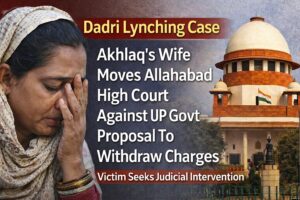
December 24, 2025IntroductionIn a significant legal development in the long-running 2015 Dadri lynching case, the wife of lynching victim Mohammad Akhlaq has approached the Allahabad High Court challenging the Uttar Pradesh government’s attempt to withdraw criminal prosecution against the accused.The petition raises critical constitutional and criminal jurisprudence issues concerning the limits of executive power in criminal prosecutions and the rights of victims to seek justice in serious offences. Background: The Dadri Lynching TragedyOn 28 September 2015, Mohammad Akhlaq, a resident of Bisada village in Greater Noida, was beaten to death by a mob on suspicion of possessing and consuming beef. The incident triggered nationwide outrage and debate on mob violence and communal vigilantism.An FIR was registered under multiple provisions of the Indian Penal Code, including murder, attempt to murder, rioting, and unlawful assembly. Eighteen accused were arrested, including minors. State’s Attempt to Withdraw ProsecutionIn October 2025, the Uttar Pradesh government moved an application under Section 321 of the Code of Criminal Procedure seeking withdrawal of prosecution against the accused.The stated grounds included alleged inconsistencies in witness statements and absence of certain weapons. The victim’s family opposed this move, contending that it lacked legal justification. High Court Challenge by Akhlaq’s WifeAkhlaq’s wife has filed a writ petition before the Allahabad High Court challenging the government order directing withdrawal, the consequential prosecutorial actions, and the application under Section 321 CrPC.The petition asserts that executive discretion in serious criminal cases must conform to constitutional principles and cannot override victims’ rights. Section 321 CrPC and Judicial ScrutinyWithdrawal of prosecution under Section 321 CrPC requires consent of the trial court. Courts must independently assess whether such withdrawal would result in a miscarriage of justice. Trial Court Rejects Withdrawal PleaThe trial court rejected the State’s application, holding that it lacked legal basis and directed the trial to proceed on a day-to-day basis with witness protection measures. Victim Family’s Stand and Public InterestThe victim’s family has consistently maintained that withdrawal of prosecution in a mob lynching case would erode public confidence in the criminal justice system. Constitutional and Legal ImplicationsLimits on executive discretion in criminal prosecution Recognition of victims as stakeholders in criminal proceedings Judicial duty to prevent miscarriage of justiceConclusionWith the trial court rejecting the withdrawal plea and the High Court now seized of the challenge, the judiciary remains central to ensuring that justice follows due process. The outcome will significantly shape jurisprudence on prosecutorial discretion and victims’ rights in India. Disclaimer: This article is for informational and academic purposes only and does not constitute legal advice. The views expressed are personal. Read more...
December 24, 2025Testamentary Freedom Prevails Over Claims of Equal Inheritance By Adv. M. N. Khan Advocate, Chandrapur IntroductionAfter a series of landmark rulings strengthening gender equality and women’s property rights, the Supreme Court of India has delivered a judgment that has sparked significant legal and social debate.In a case concerning testamentary succession, the apex court upheld a father’s will excluding one of his daughters from inheritance on the ground that she had married outside her community.Reversing the findings of both the Trial Court and the High Court, the Supreme Court reaffirmed the principle of absolute testamentary freedom under Indian succession law. Factual Background of the CaseThe dispute arose from the will executed by N. S. Sridharan, who had nine children, including one daughter, Shaila Joseph. The will expressly excluded her from inheritance on the stated ground that she had married outside the community.The Trial Court and the High Court questioned the genuineness of the will and directed equal distribution among all nine children. The beneficiaries under the will challenged these findings before the Supreme Court. Key Legal Question Before the Supreme CourtWhether a testator has the legal right to exclude a legal heir from inheritance through a valid will, even if the reason for exclusion is personal, social, or community-based. Supreme Court’s RulingA testator has absolute freedom to dispose of self-acquired property through a will Courts cannot substitute moral or social notions for testamentary intent Exclusion of a legal heir does not invalidate a lawful willTestamentary Freedom Under Indian LawThe Court reiterated that Indian succession law does not recognise compulsory inheritance. A legal heir has no vested right in property during the lifetime of the testator. Why the High Court’s Reasoning FailedInequality alone does not render a will suspicious Moral reasoning cannot replace legal reasoning Gender equality principles do not override testamentary autonomyMarriage Outside Community: Legal PositionThe Supreme Court clarified that the motivation behind exclusion is legally irrelevant so long as the will is validly executed and proved. Courts cannot judge personal beliefs or preferences of a testator. Proof of Will: Reaffirmed PrinciplesProper execution and attestation Absence of coercion or undue influence Mental capacity of the testatorBroader ImplicationsThe ruling reinforces will-writing autonomy and places clear limits on judicial interference in testamentary matters. ConclusionBy upholding the will despite exclusion of a daughter, the Supreme Court has drawn a clear legal boundary between inheritance by law and inheritance by choice. Equality governs intestate succession, not testamentary disposition. Citation: Supreme Court of India, Testamentary Succession Judgment on exclusion of daughter from will on grounds of inter-community marriage Disclaimer: This article is for informational purposes only and does not constitute legal advice. The views expressed are personal to the author. Read more...
December 24, 2025Child Trafficking and Commercial Sexual Exploitation: A Deeply Disturbing Reality Supreme Court Lays Down Sensitive Guidelines for Appreciating Evidence of Minor Victims By Adv. M. N. Khan Advocate, Chandrapur IntroductionCalling child trafficking and commercial sexual exploitation a deeply disturbing reality in India, the Supreme Court of India has once again foregrounded the urgent need for a victim-centric, humane, and legally sensitive approach while adjudicating cases involving minor victims.In its judgment delivered on Friday, December 19, the apex court laid down detailed guidelines directing courts on how the evidence of child victims must be appreciated, evaluated, and understood.The Court issued a clear caution against rejecting testimony merely due to minor inconsistencies, delays, or stereotypical expectations of conduct, recognising that child victims operate under coercion, fear, trauma, and systemic abuse. Child Trafficking in India: The Grim Context Child trafficking remains one of the gravest human rights violations in India. Children continue to be trafficked for:Commercial sexual exploitation Forced labour Domestic servitude Begging rackets Illegal adoption networksThe Supreme Court observed that trafficking networks thrive on poverty, social exclusion, gender discrimination, and lack of institutional safeguards. Legal Question Before the Supreme CourtThe core issue before the Court was how evidence of minor victims should be appreciated when testimony contains inconsistencies or does not conform to conventional expectations of conduct. Supreme Court’s Observations: A Victim-Centric Lens 1. Minor Inconsistencies Are NaturalThe Court clarified that trauma-induced inconsistencies are natural outcomes of prolonged abuse and psychological stress, and cannot be treated as fatal to credibility. 2. Stereotypical Notions Must Be RejectedSilence does not imply consent Delay does not imply falsehood Continued presence does not imply voluntariness3. Trafficking Operates Through Coercive ControlThe Court acknowledged that trafficking is a continuing crime sustained by threats, violence, manipulation, and economic dependence. Appreciation of Evidence: Judicial GuidelinesEvidence must be read holistically Trauma-induced inconsistencies should be expected Victim blaming must be avoided Power imbalance must be recognised Corroboration should not be insisted upon as a rule Judicial empathy must guide proceedingsInternational and Constitutional PerspectiveThe judgment draws strength from Article 21 of the Constitution and aligns Indian jurisprudence with international instruments protecting child rights and trafficking victims. Impact on Criminal Justice SystemThe ruling is likely to influence trial court adjudication, appellate scrutiny, prosecution strategies, and judicial training in trafficking cases. ConclusionBy calling child trafficking a deeply disturbing reality, the Supreme Court has delivered a judgment rooted in empathy and constitutional conscience. Survivors are not unreliable witnesses, but voices that must be heard with dignity and care. Citation: Supreme Court of India, Judgment dated 19 December 2025 Child Trafficking and Commercial Sexual Exploitation, Appreciation of Evidence Disclaimer: This article is intended for informational and academic purposes only and does not constitute legal advice. The views expressed are personal to the author. Read more...
December 24, 2025Second Application Cannot Be Rejected Merely Due to Earlier Dismissal By Adv. M. N. Khan Advocate, Chandrapur IntroductionStamp duty laws form the backbone of documentary authenticity in civil litigation and commercial transactions in India. The Indian Stamp Act, 1899, together with State amendments, imposes a statutory obligation that instruments chargeable with duty must be properly stamped before they are admitted into evidence.At the same time, courts are expected to balance strict compliance with stamp laws against the fundamental objective of justice, namely deciding disputes on their merits.A significant pronouncement by the Punjab and Haryana High Court, reported as 2025 Law Herald Online 1525, reaffirmed this balance by holding that a second application for impounding of a document cannot be dismissed merely because an earlier application was rejected. Legal Framework Governing Stamp Duty and Impounding The Indian Stamp Act, 1899 governs the levy of stamp duty on instruments. Two provisions are of particular importance.Section 33 imposes a duty on every authority receiving evidence to impound an unstamped or insufficiently stamped document. Section 35 bars admission of such documents unless duty and penalty are paid.The Issue Before the High CourtThe core question was whether a second application seeking impounding of a document can be rejected solely because an earlier application on the same issue was dismissed. High Court’s ReasoningStamp deficiency is a continuing illegality. The doctrine of res judicata does not strictly apply to stamp duty objections. Courts cannot contract out of their statutory duty. Every impounding application must be decided on merits.Implications for Courts and PractitionersTrial courts must independently examine stamp duty objections. Appellate courts cannot grant immunity to unstamped documents. Advocates must ensure compliance at the earliest stage to avoid delays and adverse consequences. Relevance in Property and Commercial LitigationThe ruling has far-reaching implications in property disputes, commercial contracts, recovery suits, and cases involving agreements to sell, powers of attorney, and lease deeds. ConclusionThe ruling reinforces the principle that statutory duties cannot be overridden by procedural shortcuts. An insufficiently stamped document remains legally defective until the law is complied with, regardless of earlier judicial orders. Citation: Stamp Duty, Impounding of Document, Second application must be decided on merits, Punjab and Haryana High Court, 2025 Law Herald Online 1525 Disclaimer: This article is intended for academic and informational purposes only and does not constitute legal advice. The views expressed are personal to the author. Read more...
December 23, 2025New Delhi | Environmental & Constitutional LawSupreme Court of India | Forest Protection & State Accountability Introduction: Judicial Alarm Over Environmental DestructionIn a stern and strongly worded observation, the Supreme Court of India has expressed deep concern over large-scale encroachment and illegal occupation of forest land in the State of Uttarakhand. Describing the situation as “shocking”, the Court observed that authorities appeared to be sitting as silent spectators while forest land was being systematically grabbed in front of their eyes.The remarks were made during proceedings examining allegations of organised encroachment on forest land by private individuals and entities, coupled with alleged administrative inaction by statutory authorities entrusted with the duty to protect forest resources.The observations reflect a growing judicial unease with environmental degradation enabled not only by private actors, but also by institutional apathy and administrative failure. Background: Allegations of Rampant EncroachmentThe matter arose from reports and material placed before the Supreme Court indicating that substantial tracts of forest land in Uttarakhand were being encroached upon, converted, and utilised for non-forest purposes without lawful authority.The Court was informed that:Forest land was being occupied in a systematic manner Unauthorised constructions were coming up on such land Third-party rights were allegedly being created Despite awareness, local and state authorities failed to take effective actionThese circumstances compelled the Court to scrutinise not only the actions of encroachers, but also the conduct of government officials and forest authorities responsible for safeguarding public and environmental assets. Supreme Court’s Strong ObservationsThe Supreme Court did not mince words while addressing the issue. Expressing shock at the prevailing situation, the Court remarked that forest land was being unlawfully occupied in full public view while authorities remained mute onlookers.The Court noted that violations of such magnitude could not occur without either active collusion or gross negligence on the part of enforcement agencies. It emphasised that forest land is not merely government property, but a national and ecological asset deserving the highest degree of protection. Accountability of State AuthoritiesA central focus of the Court’s scrutiny was the role of state authorities. The Supreme Court made it clear that:Forest and revenue authorities have a statutory duty to prevent encroachment Administrative excuses cannot justify prolonged inaction Failure to act amounts to abdication of constitutional responsibilityThe Court’s reasoning reinforces that environmental governance is not a discretionary function, but a binding constitutional obligation flowing from Articles 48A and 51A(g) of the Constitution. Directions Issued by the Supreme CourtTo address the gravity of the situation, the Supreme Court issued several directions, including:Calling upon senior administrative and forest officials to explain enforcement failures Directing the constitution of a fact-finding or enquiry mechanism Restraining further creation of third-party rights on disputed forest land Ensuring protection of vacant forest land from further encroachmentThese directions indicate a judicial intent to secure meaningful corrective action rather than symbolic compliance. Environmental Jurisprudence and the Public Trust DoctrineThe Court’s intervention is firmly rooted in established principles of Indian environmental jurisprudence. Forests are held by the State in public trust for present and future generations, and failure to protect them undermines sustainable development and inter-generational equity.Judicial precedent has consistently recognised that:Forest land cannot be diverted except in accordance with law Environmental protection forms an integral part of the right to life under Article 21 State authorities act as trustees, not owners, of natural resourcesThe present observations reaffirm these principles in clear and uncompromising terms. Broader Implications of the Order For State GovernmentsThe ruling sends a strong warning that environmental inaction will invite judicial scrutiny and that passive administration will not be tolerated. For Forest and Revenue AuthoritiesOfficials responsible for protecting forest land may be required to account personally for lapses, particularly where encroachments occur openly and over extended periods. For Private EncroachersThe Court’s observations make it clear that illegal occupation of forest land, even if longstanding, does not acquire legitimacy and may invite eviction, demolition, and legal consequences. Judicial Concern Over the Normalisation of EncroachmentOne of the most troubling aspects highlighted by the Court is the apparent normalisation of forest encroachment. The observation that such grabbing is occurring “in front of their eyes” reflects deep judicial concern over how environmental violations are increasingly treated as routine or inevitable.The Supreme Court’s intervention seeks to disrupt this dangerous complacency and restore accountability. ConclusionThe Supreme Court’s strong remarks against administrative silence in the face of forest land encroachment mark a significant moment in environmental enforcement jurisprudence. By calling out not only violators but also regulators, the Court has reinforced the principle that environmental protection begins with accountability.The message is unequivocal: forest land is not expendable, and those entrusted with its protection cannot remain spectators to its destruction. Read more...
December 23, 2025When Procedure Becomes a Question of Justice: Limits of Section 311 CrPCSupreme Court of India | Criminal Trial JurisprudenceSection 311 CrPC | Recall of Witnesses | Fair Trial Author Adv. Nazim Khan Advocate & Legal ConsultantCriminal Law & Trial Practice Introduction: When Procedure Becomes a Question of JusticeSection 311 of the Code of Criminal Procedure, 1973 occupies a distinctive place in the framework of criminal trials. It empowers a court, at any stage of inquiry or trial, to summon, recall, or re-examine any person as a witness if such evidence appears to be essential for a just decision of the case. By its very design, the provision prioritises substance over form and truth over technicality.Yet, courtroom experience reveals that Section 311 applications are often deployed not as instruments of justice, but as tools of convenience, frequently at belated stages of trial. The Supreme Court’s recent judgment setting aside the Gujarat High Court’s order permitting the recall of an 11-year-old child witness brings renewed focus to the limits of judicial discretion under Section 311 CrPC.The ruling is not confined to the facts of a child witness. It speaks to the integrity of criminal trials, the protection of accused persons, and the need to prevent procedural powers from degenerating into tactical weapons. Factual Background: How the Controversy AroseIn the case under consideration, the prosecution had already examined 21 witnesses when it moved an application under Section 311 CrPC seeking permission to examine an 11-year-old girl as a witness. The child was neither named in the FIR nor cited as a witness during the investigation stage.The trial court rejected the application after recording detailed reasons, including:The advanced stage of the trial The tender age of the child at the time of the incident The complete absence of explanation for the delay The likelihood of prejudice to the accusedThe Gujarat High Court, however, interfered with the trial court’s order and allowed the prosecution’s request, leading to an appeal before the Supreme Court. The Central Legal IssueThe Supreme Court was required to determine whether the High Court was justified in exercising its supervisory jurisdiction to permit recall of a minor witness under Section 311 CrPC, and whether the proposed testimony could genuinely be described as indispensable for discovering the truth. Supreme Court’s Reasoning: Sparing Use of Section 311 CrPCThe Supreme Court held in unequivocal terms that the power under Section 311 CrPC must be exercised sparingly and only where the evidence sought to be introduced is indispensable for the just decision of the case. The provision does not confer an unfettered right upon either the prosecution or the defence.Restoring the trial court’s order, the Supreme Court clarified that mere relevance or desirability of evidence is insufficient. The evidence must be so vital that without it, the truth cannot be effectively unearthed. Indispensability, Not ConvenienceA significant contribution of the judgment lies in its clarification of the term “essential” used in Section 311. The Court held that evidence is not indispensable merely because:It may strengthen a party’s case It introduces an additional perspective It seeks to fill an omissionEvidence becomes indispensable only when its absence would undermine the very foundation of a just adjudication. In the present case, extensive evidence had already been led, and nothing suggested that the trial would collapse without the child’s testimony. Child Witnesses: Judicial Sensitivity and Fair TrialThe recall of a minor witness introduces an added layer of concern. Courts have consistently recognised that child witnesses are vulnerable to suggestion, coaching, and psychological stress. When such witnesses are sought to be examined after a long lapse of time, the reliability of memory itself becomes suspect.The Supreme Court’s refusal to permit recall reflects a calibrated balance between the search for truth, the welfare of the child, and the accused’s right to a fair and timely trial. Delay as a Determining FactorDelay played a decisive role in the Court’s reasoning. The prosecution failed to offer any plausible explanation for not examining the witness earlier. Applications moved at an advanced stage of trial raise legitimate concerns of afterthought and strategic improvisation.The Court reaffirmed that unexplained delay weakens the credibility of Section 311 applications and casts serious doubt on their bona fides. Respect for Trial Court DiscretionThe Supreme Court emphasised that the trial court had passed a reasoned and well-considered order. Interference with such discretionary decisions is warranted only in cases of manifest illegality or perversity. Sound procedural discretion exercised by trial courts deserves judicial deference. Fair Trial Is Not Prosecution-CentricThe judgment reiterates that a fair trial does not translate into unlimited latitude for the prosecution. Fairness operates bilaterally. Endless recall of witnesses, especially at late stages, erodes the accused’s right to certainty and finality, both of which form part of Article 21 of the Constitution. Section 311 CrPC and the Prohibition on Filling LacunaeReaffirming settled law, the Supreme Court held that Section 311 cannot be used to fill lacunae in the prosecution case. A lacuna represents a structural deficiency, not a mere oversight. Permitting recall to cure such defects would distort the balance of criminal justice. Broader Impact of the JudgmentThe ruling serves as a guiding precedent for:Trial courts resisting mechanical recall applications Prosecutors exercising diligence during investigation Defence counsel safeguarding fair trial rights Appellate courts exercising restraintIt reinforces discipline in criminal procedure and strengthens faith in principled adjudication. ConclusionThe Supreme Court’s ruling is a reaffirmation of restraint, balance, and constitutional fairness. Section 311 CrPC remains a powerful procedural tool, but its misuse undermines the credibility of criminal trials.By drawing a clear line, the Court has ensured that the pursuit of truth does not become an excuse for procedural excess. In an adversarial system, justice is best served not by limitless flexibility, but by disciplined judicial discretion. Read more...
December 23, 2025New Delhi | Criminal Procedure & Constitutional Law Supreme Court of IndiaIntroduction In a significant reaffirmation of settled criminal jurisprudence, the Supreme Court of India has set aside an order of the Allahabad High Court which, while declining to quash a First Information Report (FIR), simultaneously imposed a fixed timeline for completion of investigation and granted protection from arrest to the accused until cognizance was taken by the trial court. The judgment draws a clear boundary on the scope of powers exercisable by High Courts under Article 226 of the Constitution and Section 482 of the Code of Criminal Procedure, 1973. The Supreme Court categorically held that such directions, issued after refusing to quash an FIR, amount to an impermissible exercise of jurisdiction and run contrary to established precedent.Background of the Case The matter arose from an FIR registered in the State of Uttar Pradesh. The accused persons approached the Allahabad High Court invoking its inherent jurisdiction, seeking quashing of the FIR on multiple grounds. The High Court declined to quash the FIR and permitted the investigation to continue. However, while refusing the substantive relief, the Court issued two consequential directions.Direction to complete the investigation within a fixed period Protection from arrest to the accused until cognizance was takenAggrieved by these directions, the State of Uttar Pradesh approached the Supreme Court contending that the High Court had effectively granted impermissible anticipatory protection.Core Issue Before the Supreme Court The principal issue before the Supreme Court was whether a High Court, after refusing to quash an FIR, can:Direct time-bound completion of investigation as a matter of course Grant blanket protection from arrest till cognizance is takenThe issue went to the heart of the balance between judicial oversight and investigative autonomy.Supreme Court’s Findings and Reasoning 1. Refusal to Quash FIR Ends the Matter at That Stage The Court held that once a High Court concludes that no case is made out for quashing an FIR, the investigation must proceed in accordance with law. Issuing protective or supervisory directions thereafter alters the legal consequence of refusal and creates a category not contemplated under the CrPC. Refusal to quash an FIR cannot be accompanied by directions that dilute statutory powers of investigation or arrest. 2. “No Arrest” Protection Is Backdoor Anticipatory Bail The Supreme Court expressed concern over the growing tendency of granting protection from arrest while disposing of FIR quashing petitions. It held that such directions amount, in substance, to anticipatory bail granted without compliance with Section 438 CrPC. Anticipatory bail is a separate statutory remedy with defined parameters. Granting similar relief indirectly undermines the legislative scheme. 3. Fixed Investigation Timelines Must Be Exceptional While courts may intervene in cases of inordinate or unexplained delay, the Supreme Court clarified that directing time-bound investigations must remain exceptional. Imposing rigid timelines without demonstrated delay or mala fides amounts to unwarranted judicial interference in police functions. 4. Adherence to Established Precedent The Court reiterated settled principles governing limited interference at the FIR stage, judicial restraint in arrest matters, and the clear distinction between quashing jurisdiction and bail jurisdiction.Implications of the Judgment For High Courts The judgment underscores the need for restraint in FIR quashing matters. Once quashing is refused, criminal law must ordinarily be allowed to take its course without additional protective conditions. For Investigating Agencies The ruling reinforces investigative autonomy and limits routine judicial supervision except in exceptional circumstances. For Accused Persons Protection from arrest cannot be claimed as a matter of course in quashing proceedings. Statutory remedies such as anticipatory bail must be invoked independently. For Criminal Jurisprudence The decision strengthens procedural discipline and preserves the separation between different criminal law remedies.A Reaffirmation of Procedural Clarity The ruling restores clarity by drawing a firm distinction between the power to quash an FIR, the power to grant anticipatory bail, and the limited circumstances in which investigation can be judicially monitored.Conclusion By setting aside the Allahabad High Court’s directions, the Supreme Court has curbed judicial overreach in criminal investigations and reinforced adherence to statutory procedure. The judgment preserves the rule of law by ensuring that refusal to quash an FIR logically permits investigation to proceed unhindered, maintaining the structural balance between judiciary and investigating agencies. Read more...
December 23, 2025Supreme Court of India | Landmark PoSH ClarificationDr. Sohail Malik v. Union of IndiaDecision dated: 10 December 2025 Author Adv. Nazim Khan PoSH Practitioner Advocate & Legal Consultant(Workplace Sexual Harassment Law, Compliance & Advisory) I. IntroductionThe Sexual Harassment of Women at Workplace (Prevention, Prohibition and Redressal) Act, 2013 (PoSH Act) was enacted as a remedial statute rooted in constitutional guarantees of equality, dignity, and a safe working environment. Over a decade since its enactment, courts have been repeatedly called upon to clarify whether PoSH should function as a protective framework or be reduced to a procedural compliance mechanism.In a significant pronouncement delivered on 10 December 2025, the Supreme Court of India reaffirmed that access to justice under the PoSH regime cannot be curtailed by technical or jurisdictional objections. The Court clarified that a woman is entitled to file a PoSH complaint before the Internal Complaints Committee (ICC) of her own workplace even where the respondent is employed in a different organisation or department.This ruling consolidates PoSH jurisprudence by firmly placing substance over form and protection over procedure. II. Background: Evolution of the PoSH Framework in India A. Constitutional and International FoundationsThe PoSH Act is not a standalone legislative instrument. Its foundations lie in Articles 14, 15, and 21 of the Constitution of India, India’s obligations under the Convention on the Elimination of All Forms of Discrimination Against Women (CEDAW), and the landmark Vishaka v. State of Rajasthan judgment, which recognised workplace sexual harassment as a violation of fundamental rights.The Vishaka Guidelines were framed to ensure immediate access to remedies pending legislative enactment. This philosophy of accessibility and protection was later codified in the PoSH Act. B. Legislative Intent of the PoSH Act, 2013Prevention of sexual harassment Redressal through accessible internal mechanisms Employer responsibility Speedy and non-intimidating processesImportantly, ICCs are not conceived as courts of strict jurisdiction but as facilitative bodies meant to enable redressal. III. The Practical Problem: Jurisdictional and Cross-Entity ComplaintsDespite the remedial intent of the statute, implementation challenges emerged. One recurring issue has been cross-entity complaints where the complainant and respondent are employed in different organisations or where incidents arise during work-related interactions.Respondent not employed with the organisation Incident outside organisational control Complaint redirected to respondent’s ICCSuch objections often resulted in denial of effective remedies and fragmented access to justice. IV. The Supreme Court’s Clarification: Core HoldingIn Dr. Sohail Malik v. Union of India, the Supreme Court decisively addressed this issue.A woman may file a PoSH complaint before the ICC of her own workplace. This right subsists even if the respondent is employed in a different organisation. Procedural or technical objections cannot defeat the protective purpose of the PoSH law.The Court reaffirmed that procedure cannot override protection. V. Interpretation of ICC Jurisdiction: Facilitative, Not Restrictive A. ICC as a Protective MechanismIn-house grievance redressal mechanism Designed for immediate access Minimal formalityB. Jurisdiction as a Tool, Not a BarrierJurisdiction under PoSH exists to enable inquiry, not to block it. ICCs must interpret their mandate purposively rather than territorially. VI. Comparative Jurisprudence: Proceduralism vs ProtectionAspect Restrictive View Protective ViewICC Jurisdiction Limited FacilitativeCross-Entity Complaints Rejected Entertained XIV. ConclusionThe Supreme Court’s clarification marks a decisive reaffirmation of the protective soul of the PoSH Act. By holding that procedural technicalities cannot override access to justice, the Court has strengthened the remedial architecture of workplace harassment law in India.PoSH is not about jurisdictional turf. It is about dignity, safety, and accountability. It must be interpreted to protect, not restrict. DisclaimerThe views expressed in this article are solely those of the author and are intended for academic, informational, and professional discussion purposes only. This article does not constitute legal advice or solicitation. Readers are advised to consult a qualified legal professional before acting upon any information contained herein. Read more...
December 22, 2025Every New Year brings with it a familiar ritual—resolutions that sound inspiring on the first day of January and become irrelevant by the end of the month. In the legal profession, resolutions are often discussed casually but rarely implemented seriously. Perhaps this is because advocates are trained to prioritise everyone else’s problems before their own.However, the nature of legal practice has changed drastically over the last decade. Two issues now demand the immediate attention of every advocate, irrespective of seniority, location, or area of practice: personal health and artificial intelligence. Ignoring either is no longer optional; both directly affect professional competence and credibility.This article is not written as a motivational piece, but as a professional reflection drawn from day-to-day legal practice.The Unspoken Reality: Advocate Health Is in DeclineThe legal profession rarely acknowledges it openly, but a large number of advocates suffer from lifestyle-related health issues. Long court hours, unpredictable schedules, constant pressure from clients, delayed payments, and the mental burden of litigation take a serious toll.In district courts and High Courts alike, advocates routinely skip meals, survive on tea, sit for hours without movement, and work late nights preparing drafts or reading files. Over time, this leads to:Chronic fatigue Blood pressure and sugar-related issues Back, cervical, and posture-related problems Anxiety and sleep disorders Early professional burnoutWhat is more concerning is that many advocates accept this condition as “normal” and even inevitable.Health Is Not a Luxury for AdvocatesAn advocate’s work depends entirely on mental clarity, patience, and sustained focus. Poor health directly affects drafting quality, courtroom arguments, and decision-making. A tired advocate is more likely to miss details, lose composure, or compromise on preparation.A practical New Year resolution for advocates must begin with accepting that health is inseparable from professional responsibility.Simple but realistic changes can make a measurable difference:Maintaining fixed meal times as far as court work permits Daily walking or light physical activity Reducing unnecessary late-night work Learning to decline non-essential professional engagementsThese are not lifestyle trends; they are survival tools for long-term legal practice.Artificial Intelligence: Fear, Misuse, and the Need for Legal MaturityArtificial intelligence has entered the legal field quietly but firmly. Legal research platforms, drafting tools, document review systems, and case-management software are already part of modern practice. Yet, within the Bar, reactions to AI remain largely emotional rather than informed.Some fear that AI will replace junior advocates. Others use AI blindly, copying drafts without verification. Both approaches are professionally dangerous.AI Is Neither the Enemy Nor the SaviourFrom a practitioner’s perspective, AI is best understood as an assistant, not an advocate. It can save time on routine tasks but cannot replace legal reasoning, ethical judgment, or courtroom advocacy.AI can assist with:Preliminary legal research Structuring drafts Summarising judgments Managing case dataAI cannot:Decide legal strategy Fully understand factual nuances Argue before a court Assume responsibility for errorsAn advocate who treats AI as a shortcut rather than a tool risks professional embarrassment and ethical consequences.Ethical Responsibility While Using AIOne of the most serious risks associated with AI is the generation of incorrect case laws, imaginary citations, and misleading legal interpretations. Any advocate using AI must remember one fundamental principle:The responsibility for every word filed or argued in court rests solely with the advocate.A meaningful New Year resolution in this context would include:Never filing AI-generated content without independent verification Cross-checking all citations and legal propositions Maintaining client confidentiality while using digital tools Using AI to support thinking, not replace it Read more...
December 22, 2025IntroductionLandlord–tenant disputes in India often take a long and winding course, particularly when issues of title, succession, and bona fide requirement are raised together. A common defence adopted by tenants is to dispute the landlord’s ownership, sometimes decades after accepting the tenancy and regularly paying rent.In Jyoti Sharma v. Vishnu Goyal & Anr., decided on 11 September 2025, the Supreme Court once again clarified settled principles governing eviction suits. The Court addressed:Whether a tenant can dispute the title of the landlord or successor, The standard of proof of ownership in eviction proceedings, The evidentiary value of a Will and probate, and The assessment of bona fide requirement.The judgment corrects what the Court described as perverse findings based on conjectures and carries significant implications for landlord–tenant litigation across the country.Factual Background in BriefThe tenancy originated in 1953, when the disputed shop was let out by the original landlord, Ramji Das. Upon his death in 1999, ownership of the property was claimed by his daughter-in-law under a Will dated 12 May 1999.The plaintiff sought recovery of arrears of rent from January 2000 and eviction of the tenants on the ground of bona fide requirement, asserting her intention to expand the family business operating from the adjoining premises.The tenants resisted the suit by disputing the landlord’s title, alleging that the Will was fraudulent, and denying attornment of tenancy in favour of the plaintiff.Despite decades of rent payment to the landlord and his family, both the trial court and the High Court dismissed the suit, leading the matter to the Supreme Court.Core Legal Issues ConsideredThe Supreme Court examined the dispute through settled principles of landlord–tenant law rather than speculative reasoning. The central issues were:Whether a tenant can dispute the title of the landlord or successor, Whether strict proof of ownership is required in eviction suits, The effect of a Will and probate in such proceedings, and The proper test for assessing bona fide requirement.Tenant’s Estoppel Against Denial of TitleThe Court reaffirmed the doctrine of tenant’s estoppel. It held that a tenant who entered into possession under a landlord cannot subsequently challenge that landlord’s title, particularly after admitting execution of the rent deed and paying rent for several decades.In the present case, the tenants had accepted Ramji Das as landlord since 1953. The Court found it impermissible for them to dispute his ownership at such a belated stage.This principle flows directly from Section 116 of the Evidence Act, 1872, which bars a tenant from denying the landlord’s title at the commencement of the tenancy.Proof of Ownership in Eviction SuitsThe Supreme Court clarified that an eviction suit is not a title suit. A landlord is not required to prove absolute ownership as would be necessary in a declaratory suit.It is sufficient for the landlord to establish a better right to possession than the tenant. By insisting on strict proof of ownership and disbelieving the Will on conjectural grounds, the courts below applied an incorrect legal standard.ConclusionThe Supreme Court’s ruling decisively reaffirms that tenants cannot question the title of the very person who inducted them into possession. It also restores clarity on the limited scope of eviction proceedings and the proper assessment of bona fide requirement.The judgment serves as a strong reminder that procedural technicalities and speculative reasoning cannot override settled principles of landlord–tenant law. Read more...
December 22, 2025Introduction: Travel, Liberty, and the Weight of a Criminal CaseIn modern India, possession of a passport is no longer a mere travel convenience. It is often essential for livelihood, education, business, medical treatment, and personal liberty. Yet, the law has consistently maintained that the right to travel abroad, though flowing from Article 21 of the Constitution, is not absolute. It remains subject to statutory regulation, principally under the Passports Act, 1967.The Supreme Court’s decision in SLP (Civil) No. 17769 of 2025, Mahesh Kumar Agarwal v. Union of India & Anr. brings renewed clarity to a recurring and contentious issue.Can a passport authority refuse issuance or renewal of a passport merely because a criminal case is pending, even when courts have granted limited permissions?The ruling does not introduce new law. Instead, it restores statutory discipline in an area increasingly clouded by inconsistent judicial directions and administrative uncertainty.Factual Background: How the Dispute AroseThe petitioner, Mahesh Kumar Agarwal, was an Indian citizen holding a valid passport that expired in the year 2023. At the time of expiry, criminal proceedings were pending against him, arising from a prosecution initiated by a central investigating agency.Upon applying for renewal, the application was not processed in the ordinary course. The passport authority invoked Section 6(2)(f) of the Passports Act, 1967, which empowers refusal of passport issuance where criminal proceedings are pending before a court in India.The petitioner relied on certain judicial orders passed during the pendency of the criminal case, which permitted him to take steps for passport renewal subject to conditions. However, the passport authority declined to issue a full-term passport. This resulted in writ proceedings and ultimately an appeal before the Supreme Court.The Central Legal IssueThe controversy before the Supreme Court revolved around a deceptively simple but legally significant question.Is renewal of an expired passport a continuation of an existing right, or is it equivalent to fresh issuance attracting statutory disqualifications under the Passports Act?Connected to this were ancillary issues including whether interim judicial permissions override statutory bars, whether pendency of a criminal case automatically disables passport renewal, and the extent to which Article 21 can dilute legislative restrictions.Statutory Scheme: The Passports Act, 1967A proper understanding of the judgment requires returning to the statutory framework.Under the Passports Act, 1967, Section 5 governs applications for passports, while Section 6 specifies grounds on which issuance or renewal may be refused.Section 6(2)(f) is pivotal. It mandates refusal of passport issuance where criminal proceedings are pending before a court in India, unless the concerned court grants specific permission. The provision is couched in mandatory language, leaving little scope for administrative discretion.This statutory command formed the backbone of the Supreme Court’s reasoning.Renewal vs Issuance: The False DichotomyA recurring argument in such cases is that renewal stands on a different footing from fresh issuance. The Supreme Court categorically rejected this distinction.Once a passport expires, it ceases to have legal existence. Renewal after expiry is not a mechanical extension but a fresh exercise of statutory power. All eligibility conditions and disqualifications under the Act apply equally.This reasoning effectively closes the door on attempts to bypass statutory restrictions by labeling an application as renewal rather than issuance.Judicial Permissions vs Statutory BarThe Court also examined the legal effect of judicial orders passed during criminal proceedings. The petitioner relied on court orders that permitted steps toward passport renewal.The Supreme Court clarified that such permissions cannot override statutory mandates unless the court expressly authorizes issuance of a passport in clear terms. Administrative authorities remain bound by the statute and cannot infer permissions beyond what is expressly granted. Read more...
December 21, 2025Compromise under Section 125 CrPC Does Not Bar Maintenance under Personal Law A Revisit of Nagendrappa Natikar v. Neelamma By Advocate Nazim Khan, Chandrapur IntroductionMaintenance laws in India are intended to prevent destitution and vagrancy. However, legal disputes frequently arise when spouses enter into compromises under Section 125 of the Code of Criminal Procedure, 1973, and later one party seeks maintenance under personal law statutes such as the Hindu Adoptions and Maintenance Act, 1956.In Nagendrappa Natikar v. Neelamma, the Supreme Court examined whether a compromise or settlement under Section 125 CrPC permanently bars a wife from claiming maintenance under personal law. The Court answered this in the negative, reaffirming the limited scope of Section 125 proceedings and the independent existence of substantive maintenance rights. Factual Background of the CaseNagendrappa Natikar and Neelamma were married on 24 May 1987. Following matrimonial disputes, Neelamma initiated proceedings under Section 125 CrPC in 1992 alleging neglect and seeking maintenance.During the pendency of those proceedings, the parties entered into a compromise in 1994 under which Neelamma accepted a one-time payment of Rs. 8,000 described as permanent alimony, agreed not to claim future maintenance, and consented to live separately for health reasons. The Magistrate recorded the compromise and disposed of the proceedings accordingly.Subsequently, Neelamma approached the civil court seeking maintenance under Section 18 of the Hindu Adoptions and Maintenance Act, 1956. The husband opposed the claim, relying on the earlier compromise.Legal Issue before the Supreme CourtThe central issue before the Court was whether a compromise arrived at in proceedings under Section 125 CrPC extinguishes a wife’s statutory right to maintenance under Section 18 of the Hindu Adoptions and Maintenance Act, 1956.Nature of Proceedings under Section 125 CrPCThe Supreme Court reiterated that proceedings under Section 125 CrPC are summary in nature and aimed at providing immediate relief to prevent destitution. The Court clarified that orders passed under Section 125 do not finally determine civil or matrimonial rights and are not conclusive adjudications under personal law.Maintenance under Personal Law: A Substantive RightContrasting Section 125 proceedings with personal law remedies, the Court held that maintenance under Section 18 of the Hindu Adoptions and Maintenance Act, 1956 is a substantive statutory right flowing from the marital relationship. Such a right cannot be waived or extinguished merely through a compromise in summary criminal proceedings.Effect of Compromise in Section 125 ProceedingsThe Supreme Court held that a compromise under Section 125 CrPC does not operate as res judicata. Acceptance of a one-time settlement in such proceedings does not bar a subsequent civil claim for maintenance. Consent terms cannot override statutory protections enacted as social welfare measures.Key Legal Principles Laid DownSection 125 CrPC provides a summary remedy and does not finally adjudicate maintenance rights. Maintenance under personal law is an independent statutory right. Compromises in Section 125 proceedings do not extinguish civil maintenance claims. Social welfare legislation must receive a purposive interpretation.Impact of the JudgmentProtects dependent spouses from being left remediless due to early compromises. Prevents unfair settlements intended to avoid future obligations. Reinforces the distinction between criminal procedure and civil rights. Continues to guide family and civil courts across India.ConclusionThe judgment in Nagendrappa Natikar v. Neelamma reaffirms that summary settlements cannot defeat substantive statutory rights. By holding that a compromise under Section 125 CrPC does not bar maintenance claims under personal law, the Supreme Court ensured that welfare legislation remains effective and justice is not reduced to procedural formality.CitationNagendrappa Natikar v. Neelamma (2014) 14 SCC 452 AIR 2014 SC 1557 Supreme Court of IndiaDisclaimer: This article is intended for legal awareness and educational purposes only and does not constitute legal advice. Views expressed are based on settled judicial precedent. For family law, maintenance matters, and matrimonial litigation, contact Advocate Nazim Khan, Chandrapur. Read more...
December 21, 2025The Proposed National Commission for Men Bill, 2025 Understanding the Background, Constitutional Basis, and the Need for a Balanced Discourse By Advocate Nazim Khan, Chandrapur IntroductionIn recent times, there has been increasing public discussion around the proposal for a National Commission for Men, often referred to as the National Commission for Men Bill, 2025. While the proposal has not yet taken the shape of enacted legislation, it has brought into focus an important constitutional question: how should the legal system respond to grievances faced by men while continuing to protect women and other vulnerable groups?This discussion is not about opposing existing protections. Rather, it is about re-examining equality, dignity, and fairness through a constitutional lens, particularly Articles 14 and 21 of the Constitution of India, which apply equally to all citizens. Constitutional Framework: Equality and Dignity Are UniversalArticle 14 – Equality before law and equal protection of laws Article 15 – Prohibition of discrimination on grounds of sex Article 21 – Right to life and personal liberty, including dignity and reputation Article 38 – Obligation of the State to promote social justiceIndian courts have consistently held that equality before law is a basic feature of the Constitution and that legal processes must be fair, proportionate, and reasonable.Why Has the Idea of a National Commission for Men Emerged? 1. Absence of a Dedicated Institutional ForumIndia has statutory commissions for women, children, minorities, and scheduled communities. However, there is no statutory body specifically mandated to study or address certain issues faced by men, including alleged misuse of law, workplace harassment complaints by men, domestic disputes, custody conflicts, and mental health concerns.2. Judicial Observations on Fairness and Due ProcessConstitutional courts have repeatedly emphasized that while protective laws are necessary, safeguards against misuse and unfair deprivation of liberty are equally vital in a rule-of-law system.3. Social and Mental Health ConcernsPublic data and academic research highlight higher suicide rates among men, low reporting of abuse, and limited counselling mechanisms, which often remain outside structured policy focus.ConclusionThe debate around the proposed National Commission for Men reflects a broader constitutional conversation about fairness, dignity, and equality before law. A balanced legal system must protect vulnerable groups while ensuring that justice remains accessible and fair to all.Disclaimer: This article is written solely for public legal awareness and discussion purposes. It does not constitute legal advice. The proposal discussed is not an enacted statute. Views expressed are personal and based on constitutional principles. For legal queries relating to constitutional law, gender-neutral justice, and policy matters, contact Advocate Nazim Khan, Chandrapur. Read more...
December 20, 2025Why “Sale Confirmation” Is Not Ownership, and Why Possession Cannot Be Delivered If Moratorium Intervenes Arrow Business Development Consultants Pvt. Ltd. v. Union Bank of India & Ors. (Bombay High Court, Civil Appellate Jurisdiction, Writ Petition No. 11132 of 2025, decided on 10 December 2025) By Advocate Nazim Khan Banking, SARFAESI & Insolvency Practitioner1. Why This Case MattersSARFAESI auctions are intended to be swift recovery mechanisms for secured creditors. However, the Insolvency and Bankruptcy Code introduced a protective insolvency regime, particularly for individuals and personal guarantors, through provisions such as Section 96 (Interim Moratorium).A recurring and commercially disruptive problem arises when SARFAESI timelines clash with insolvency filings:An auction is conducted under SARFAESI The highest bid is accepted and sale is confirmed Payments continue or sale certificate is issued Meanwhile, the borrower or co-owner triggers personal insolvency under IBCThe legal question is not academic. It directly affects:Title certainty in statutory auctions Possession delivery by banks Confidence of auction purchasers Recovery timelines of secured creditorsThe Bombay High Court addressed a critical issue:If an interim moratorium under Section 96 begins after auction confirmation but before the statutory sale is completed, can the bank still accept money, issue a sale certificate, and deliver possession?2. Court and Case IdentityCourt: High Court of Judicature at Bombay, Civil Appellate Jurisdiction Case: Writ Petition No. 11132 of 2025 Neutral Citation: 2025:BHC-AS:54045-DB Date Reserved: 24 November 2025 Date Pronounced: 10 December 2025 Coram: Justice R.I. Chagla and Justice Farhan P. DubashParties: Petitioner: Arrow Business Development Consultants Pvt. Ltd. (Auction Purchaser) Respondent No. 1: Union Bank of India (Secured Creditor) Respondent No. 2: Insolvency Professional Respondent No. 3: Borrower3. The Secured AssetThe dispute concerned a residential flat:Flat No. 201, 2nd Floor, “El Castillo” Building Plot No. 23/B & 23/C, Sector-6, Palm Beach Road Nerul (West), Navi Mumbai – 400706This detail was crucial because the relief sought was physical possession of the flat by the auction purchaser.4. Facts and Procedural History 4.1 Loan and NPAUnion Bank extended financial facilities to the borrowers, who mortgaged the flat as security. Upon default, the account was classified as NPA on 16 April 2023. 4.2 SARFAESI Demand NoticeA demand notice under Section 13(2) SARFAESI was issued on 24 April 2023. 4.3 Auction and Sale ConfirmationAuction sale notice was issued on 9 May 2025. The auction was conducted on 30 May 2025, where the petitioner emerged as the highest bidder at Rs. 9,12,25,000. 4.4 Payment Tranches The Court recorded the exact payment schedule:30 May 2025 – Rs. 91,12,500 31 May 2025 – Rs. 1,37,00,000 18–20 June 2025 – Balance six tranchesImportantly, the balance payments were made and accepted after the interim moratorium had commenced. 4.5 Insolvency TriggerOn 9 June 2025, the borrower filed a personal insolvency application under Section 94 IBC, resulting in an automatic interim moratorium under Section 96. 4.6 Sale CertificateThe sale certificate was issued on 20 June 2025, during the moratorium period. 4.7 DRT ProceedingsBorrowers approached the DRT under Section 17 SARFAESI. The DRT noted the moratorium and refrained from granting substantive relief.5. Timeline at a GlanceDate Event Legal Significance30 May 2025 Auction held Bid accepted9 June 2025 IBC Section 94 filing Interim moratorium begins18–20 June 2025 Balance payments During moratorium20 June 2025 Sale certificate issued Core dispute10 Dec 2025 Bombay HC judgment Possession denied6. Legal Issue FramedWhether, after the amendment to Section 13(8) SARFAESI, the borrower’s ownership stands extinguished merely upon issuance of the auction sale notice.7. Findings of the CourtOwnership under SARFAESI passes only upon issuance of a valid sale certificate Extinguishment of redemption is not equivalent to transfer of ownership Section 96 interim moratorium is wide and operates immediately upon filing Steps taken during moratorium cannot complete statutory sale8. Why the Auction Purchaser FailedThe Court held that confirmation of sale is not completion of sale. Since substantial payments and the sale certificate were issued during the moratorium, ownership did not legally crystallise.9. Practical Impact For BanksMonitor insolvency filings even after auction confirmation Avoid accepting payments during moratoriumFor Auction PurchasersTitle is secure only after valid sale certificate Conduct insolvency diligence before post-auction payments10. ConclusionThe judgment reaffirms that statutory ownership does not pass merely on confirmation of sale. If an interim moratorium intervenes before lawful completion, possession cannot be enforced.Disclaimer: This article is for general legal awareness and does not constitute legal advice. For SARFAESI, IBC, and Banking Recovery Queries: Contact Advocate Nazim Khan Read more...
December 18, 2025Important RBI NPA Classification Update What Every Borrower, Co-Borrower and Co-Obligant Must Know By Advocate Nazim Khan For ChandrapurLawyer.com IntroductionIn light of recent communications issued by Federal Bank regarding updates to Non-Performing Asset classification, it is essential for borrowers, co-borrowers, and co-obligants to clearly understand the Reserve Bank of India regulatory framework governing these changes.The applicable rules have been formally consolidated and reiterated by the RBI through its latest master circular. Misunderstanding these norms can result in serious financial and legal consequences. RBI Master Circular on IRACP Norms The Reserve Bank of India has consolidated the prudential norms relating to Income Recognition, Asset Classification and Provisioning through the following circular:Circular Number: RBI/2024-25/12 Reference: DOR.STR.REC.8/21.04.048/2024-25 Date: April 2, 2024 Subject: Prudential norms on Income Recognition, Asset Classification and Provisioning pertaining to Advances Applicability: All Commercial Banks excluding Regional Rural BanksThis master circular consolidates all RBI instructions issued up to March 31, 2024 and clearly reiterates that asset and NPA classification shall be borrower-wise and not facility-wise. Meaning of Borrower-Wise NPA ClassificationIf a borrower has multiple loan or credit facilities with the same bank If any one of those facilities becomes a Non-Performing Asset All other loan accounts of that borrower are also classified as NPAs The classification continues until all arrears across all linked accounts are fully clearedThis rule applies equally to principal borrowers, co-borrowers, and co-obligants. Legal Implications for Borrowers and Co-Borrowers Joint and Several LiabilityAll borrowers are legally responsible for repayment Default by one borrower affects all linked borrowers The bank may recover dues from any or all borrowers Individual repayment discipline does not override borrower-wise classificationImpact on Credit Reports and Credit ScoreOnce an account is classified as NPA, the status is reported to Credit Information Companies. The consequences may include:Significant reduction in credit score Reduced eligibility for future loans Higher interest rates or loan rejections Long-term adverse credit impact until full regularisationRecovery and Legal Proceedings After NPA classification, banks are legally entitled to initiate recovery action, including:Issuance of demand and recall notices Proceedings under the SARFAESI Act Cases before Debt Recovery Tribunals Civil recovery suits against borrowers and co-borrowersUpgradation from NPA to Standard Asset As per RBI IRACP norms:All arrears across all linked accounts must be fully paid This includes principal, interest, penal charges, and fees Partial settlement of a single account is not sufficientPractical Guidance for BorrowersAssess financial exposure before becoming a co-borrower or co-obligant Regularly monitor repayment status of all linked loans Act immediately on early signs of default Maintain clear written arrangements among co-borrowersConclusionThe borrower-wise NPA classification norm, reaffirmed by the RBI Master Circular dated April 2, 2024, places significant responsibility on all borrowers, particularly co-borrowers and co-obligants.A single default can impact multiple loan accounts, credit history, and future financial opportunities. Timely legal awareness and proactive action are essential. AuthorAdvocate Nazim Khan ChandrapurLawyer.com Website DisclaimerThis article is published for informational purposes only and does not constitute legal advice, solicitation, or an attorney-client relationship.The legal position discussed is based on RBI regulations applicable on the date of publication and may change due to amendments or judicial interpretations.Advocate Nazim Khan and ChandrapurLawyer.com shall not be responsible for any loss or consequence arising from reliance on this information. Readers should seek independent legal advice before taking any action. Read more...
December 16, 2025The POSH Act: A Law Born from Silence, Sustained by Dignity By Adv. M. N. Khan For a long time, the Indian workplace carried an uncomfortable truth that few were willing to acknowledge openly. Women worked alongside men and contributed equally, yet many endured indignities that had no clear name, no remedy, and often no listener. What was dismissed as normal behaviour or harmless conduct was, in reality, an assertion of power that remained unchecked, unquestioned, and deeply unjust. Sexual harassment at the workplace did not suddenly emerge as a modern concern. It existed quietly and persistently, thriving in rigid hierarchies where authority went unquestioned and vulnerability remained unseen. Women were expected to tolerate discomfort for the sake of employment. Speaking up often led to being labelled difficult, ungrateful, or worse. The absence of a legal framework was not accidental. It reflected a broader social reluctance to confront wrongdoing when it was protected by power. The need for a legal response became impossible to ignore after the horrific experience of Bhanwari Devi, a woman punished not for misconduct but for her courage. Her case shook the conscience of the judiciary and compelled the nation to recognise that sexual harassment is not a private matter. It is a constitutional concern. The Vishaka Guidelines emerged as a judicial response to legislative silence, seeking to address a moral and legal vacuum. However, guidelines alone, regardless of how progressive they may be, cannot replace a statute backed by enforceability. The enactment of the Prevention of Sexual Harassment of Women at Workplace Act, 2013 marked a decisive shift. It was not simply another compliance requirement. It was a formal recognition that dignity at work is inseparable from the right to equality and the right to life. The POSH Act acknowledges that empowerment loses its meaning when safety is uncertain and that economic participation cannot thrive in an environment of fear. What sets this legislation apart is its emphasis on responsibility. The law does not ask women to be braver. It requires institutions to act better. Employers are mandated to establish mechanisms that prevent, address, and redress harassment, not as a discretionary measure but as a legal obligation. The Internal Committee is not a symbolic body. It is the backbone of enforcement. When properly constituted and effectively trained, it restores confidence in due process while safeguarding dignity and fairness for all parties involved. There is a widespread misconception that the POSH Act is adversarial in nature. This belief is both inaccurate and harmful. The Act does not presume guilt. It prescribes procedure. It calls for inquiry rather than assumption. By grounding the process in principles of natural justice, the law ensures that complaints are examined with seriousness, sensitivity, and balance. In doing so, it protects not only aggrieved women but also the integrity of the institution itself. Women empowerment cannot be measured solely by numbers, such as how many women enter the workforce or how high they rise within organisations. True empowerment lies in the freedom to work without fear, to raise objections without facing retaliation, and to trust that the system will respond fairly. The POSH Act supports this empowerment quietly yet firmly. It does not sensationalise dignity. It makes dignity a normal expectation. The effectiveness of the law, however, depends as much on intent as on implementation. Treating POSH compliance as a checklist exercise undermines its purpose. A policy that is drafted but not understood, or a committee that exists but lacks training, represents compliance only in form, not in substance. The spirit of the Act requires continuous awareness, sensitivity, and engagement. Legal guidance plays a vital role here, not to escalate conflict, but to ensure that justice remains procedural, reasoned, and humane. From professional experience, workplaces that take POSH seriously rarely do so out of fear of penalties. They do so because they recognise that respect is fundamental to productivity and trust. On the other hand, organisations that disregard the law often discover too late that reputational damage cannot be repaired through silence or denial. Ultimately, the POSH Act reflects the maturity of society itself. It reminds us that progress is measured not only by economic growth but also by values. It affirms that no workplace can be called professional if it tolerates intimidation, and no system can be considered just if it expects women to endure in silence. This law was not enacted to instil fear. It was enacted to create balance. It stands as a reminder that empowerment is not something granted casually. It must be protected deliberately. By safeguarding the dignity of women at work, the POSH Act strengthens both the moral foundation of our institutions and the constitutional promise of equality. Read more...
September 4, 2025Family is the foundation of society, but sometimes relationships face challenges that lead to separation or conflict. In such cases, the law steps in to protect the rights of spouses, children, and dependents. Family law in India covers issues like marriage, divorce, child custody, adoption, and maintenance.Among these, divorce, custody, and maintenance are the most common concerns faced by families. Understanding how Indian law addresses them can help individuals make informed decisions during difficult times.1. Divorce in IndiaDivorce legally ends a marriage and can be filed under various personal laws, such as the Hindu Marriage Act, 1955, the Special Marriage Act, 1954, or respective religious laws.Grounds for Divorce include:Cruelty (physical or mental).Adultery or infidelity.Desertion for a specified period.Mutual consent of both partners.Conversion to another religion, or incurable mental disorder.✅ Couples can opt for mutual consent divorce (simpler and quicker) or contested divorce (where one party disagrees).2. Child CustodyWhen parents separate, the welfare of the child becomes the court’s primary concern. Custody can be granted to one parent or shared, depending on the child’s best interests.Types of Custody in India:Physical Custody – Child lives with one parent while the other gets visitation rights.Joint Custody – Both parents share responsibility, often on rotation.Legal Custody – Parent has the right to make important decisions about the child’s life.✅ Indian courts prioritize the child’s emotional and physical well-being over parental disputes.3. Maintenance and AlimonyMaintenance (financial support) ensures that a spouse or child is not left without means to live after separation. It can be interim (during trial) or permanent (after divorce).Who Can Claim Maintenance?A spouse with no independent income.Minor children.In some cases, even dependent parents.✅ The amount depends on the financial capacity of the paying spouse, lifestyle, and needs of the dependents.4. Why Legal Guidance Matters in Family LawFamily matters are emotionally charged and often complex. Having an experienced lawyer ensures:Proper filing of divorce petitions.Protection of child’s rights in custody cases.Fair assessment of maintenance and alimony.Amicable settlements through mediation when possible.Final ThoughtsFamily law in India is designed to protect relationships, ensure fairness, and safeguard the interests of dependents. While separation is never easy, legal remedies like divorce, custody, and maintenance provide clarity and justice.If you are facing family law issues, consult a qualified lawyer who can guide you with compassion and professionalism. With the right support, you can navigate challenges while protecting your family’s future. Read more...