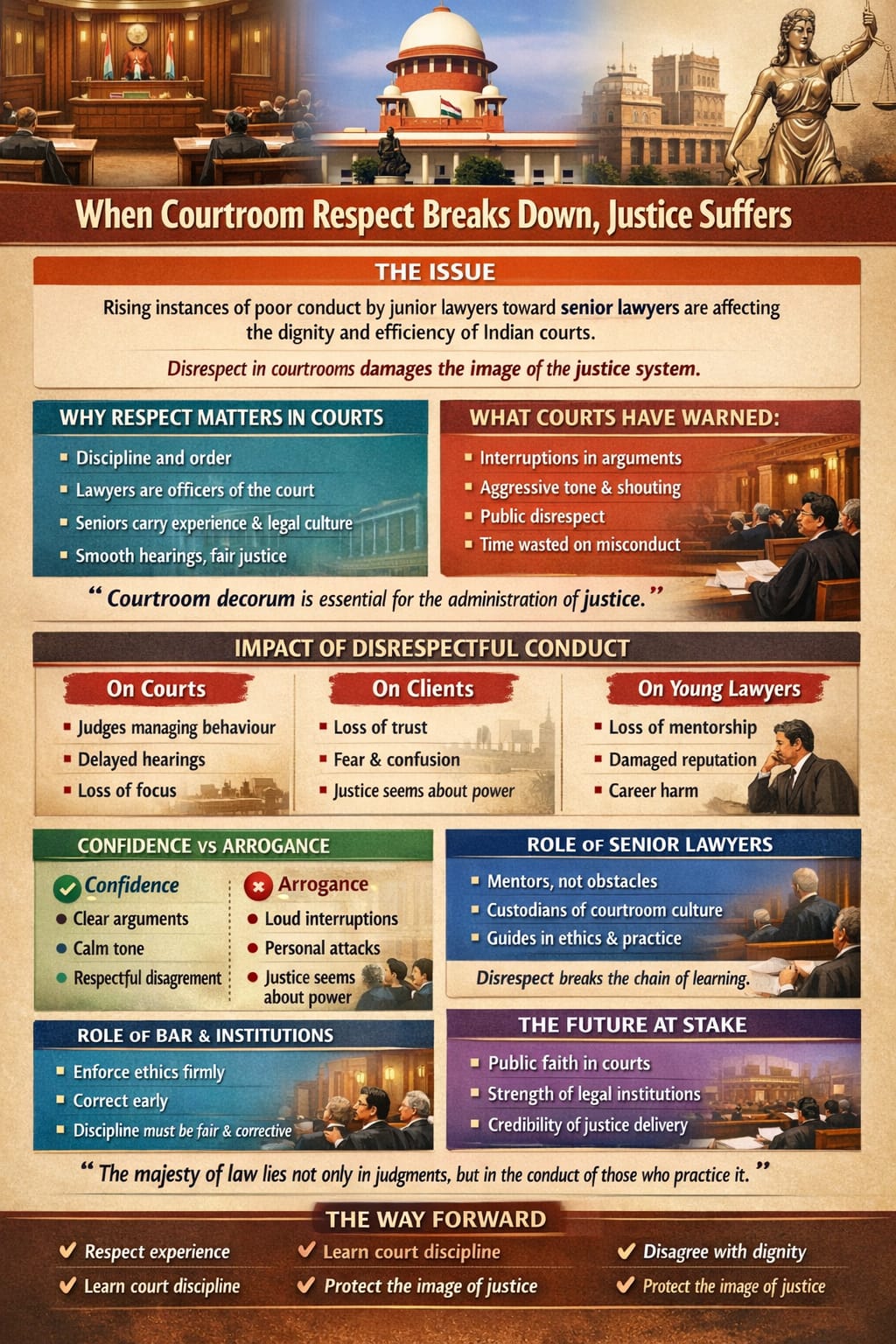
“The court is not a place for unruly behaviour. Discipline is the soul of the justice delivery system.”
This observation of the Supreme Court of India reflects a concern that goes beyond any single case. It speaks to a growing problem inside Indian courtrooms.
Indian courts are built on tradition, hierarchy, and mutual respect. From district courts to High Courts and the Supreme Court, the legal profession has always placed strong emphasis on decorum. Lawyers are not merely representatives of clients. They are officers of the court, entrusted with the responsibility of assisting judges in the administration of justice.
Yet, in recent years, Indian courts have repeatedly expressed concern over declining courtroom discipline. One worrying aspect of this decline is the increasing instances of poor conduct by junior lawyers toward senior members of the Bar. This behaviour, if left unchecked, risks damaging the credibility of India’s justice system.
Respect as the Foundation of Indian Legal Practice
In India, the relationship between senior and junior lawyers has traditionally been one of mentorship. Seniors guide juniors not only in law, but also in courtroom behaviour, ethics, and professional limits. This tradition helped maintain order even in crowded and overburdened courts.
The Supreme Court, in Mahipal Singh Rana v. State of Uttar Pradesh (2016), stressed that legal ethics and professional standards are essential to preserve public confidence in courts. The Court noted that lawyers play a key role in shaping how justice is perceived by society. When lawyers fail in discipline, the entire system suffers.
Respect toward senior lawyers is not about submission. It is about recognising experience and preserving institutional discipline. Senior advocates have spent decades understanding Indian procedural law, judicial temperament, and courtroom culture. Their conduct sets examples for younger members of the Bar.
Growing Judicial Concern Over Courtroom Misconduct
Indian courts have not remained silent on this issue. In R.K. Anand v. Registrar, Delhi High Court (2009), the Supreme Court highlighted the importance of integrity and dignity in the legal profession. The Court observed that misconduct by lawyers directly affects the administration of justice and public trust.
Several High Courts have also raised alarms. The Delhi High Court, while dealing with incidents of courtroom disruption, has remarked that aggressive and disrespectful conduct by lawyers creates chaos and delays justice. The Court warned that courts cannot become arenas for personal dominance or unchecked behaviour.
In another instance, the Bombay High Court observed that junior lawyers must learn restraint and courtroom discipline early in their careers. The Court emphasised that confidence must not cross into arrogance.
Confidence Versus Arrogance in Indian Courts
India’s legal profession is highly competitive. Young lawyers face immense pressure due to limited opportunities, delayed briefs, and financial insecurity. Ambition is natural in such an environment. However, courts have made it clear that ambition must be balanced with humility.
In Harish Uppal v. Union of India (2003), the Supreme Court emphasised that lawyers must uphold the dignity of courts and cannot resort to conduct that disrupts proceedings. Raising one’s voice or showing aggression does not strengthen an argument.
Unfortunately, some junior lawyers believe that interrupting seniors or confronting them publicly will establish authority. In Indian court culture, such behaviour has the opposite effect. Judges notice it immediately. Seniors remember it. Reputations suffer quietly but permanently.
Impact on Judges and Court Functioning
Indian courts already function under extreme pressure. Heavy caseloads, limited time, and administrative challenges require lawyers to assist rather than obstruct proceedings. When junior lawyers engage in disrespectful conduct, judges are forced to intervene unnecessarily.
The Madras High Court once observed that courts should not be reduced to spaces where judges act as disciplinarians instead of adjudicators. Time spent controlling behaviour is time taken away from delivering justice.
This loss affects litigants directly. Delays increase. Hearings are disrupted. The seriousness of the judicial process is diluted.
Loss of Public Faith in the Justice System
For many Indians, court proceedings are intimidating. Litigants enter courts with hope, fear, and uncertainty. They expect lawyers to act with professionalism and dignity. When they witness open disrespect between lawyers, their faith weakens.
In O.P. Sharma v. High Court of Punjab and Haryana (2011), the Supreme Court stated that professional misconduct by advocates erodes the image of the judiciary itself.
When clients see junior lawyers disrespecting seniors, they begin to believe that success in court depends on power struggles rather than legal merit. This belief harms the moral authority of Indian courts.
Seniors as Custodians of Legal Culture
Senior lawyers in India are more than legal experts. They are carriers of legal culture. They understand unwritten courtroom norms, judicial temperament, and professional boundaries. Juniors learn these aspects not from law books, but from observation.
Disrespect disrupts this learning chain. When seniors withdraw mentorship due to poor conduct, juniors lose valuable guidance. Over time, this weakens the collective strength of the Bar.
The Supreme Court has noted that the legal profession survives on continuity. Values must pass from one generation to the next. Without respect, this continuity breaks.
Responsibility of Bar Associations and Institutions
Indian Bar Councils and Bar Associations have a duty to address declining professional conduct. Ethics cannot remain theoretical. They must be enforced through guidance, counselling, and discipline.
In Mahipal Singh Rana, the Supreme Court made it clear that silence in the face of misconduct is not neutrality—it is neglect.
Senior lawyers also carry responsibility. Correction must be firm but fair. The aim should always be improvement, not humiliation.
A Choice That Shapes the Future of Indian Justice
Junior lawyers represent the future of India’s justice system. Their conduct today will define public trust tomorrow. Respect does not weaken independence. It strengthens credibility.
The majesty of law lies not only in judgments, but also in the conduct of those who practice it. This truth applies most strongly inside courtrooms.
If Indian lawyers choose patience over ego and learning over confrontation, the justice system will grow stronger. If disrespect becomes routine, the damage will be slow but deep.
India’s courts have survived because of discipline, tradition, and mutual respect. Preserving these values is essential. Respect for senior lawyers is, in essence, respect for the law itself. Without it, justice becomes fragile.