Explaining the Maharashtra State Waqf Tribunal’s Order in Simple Language
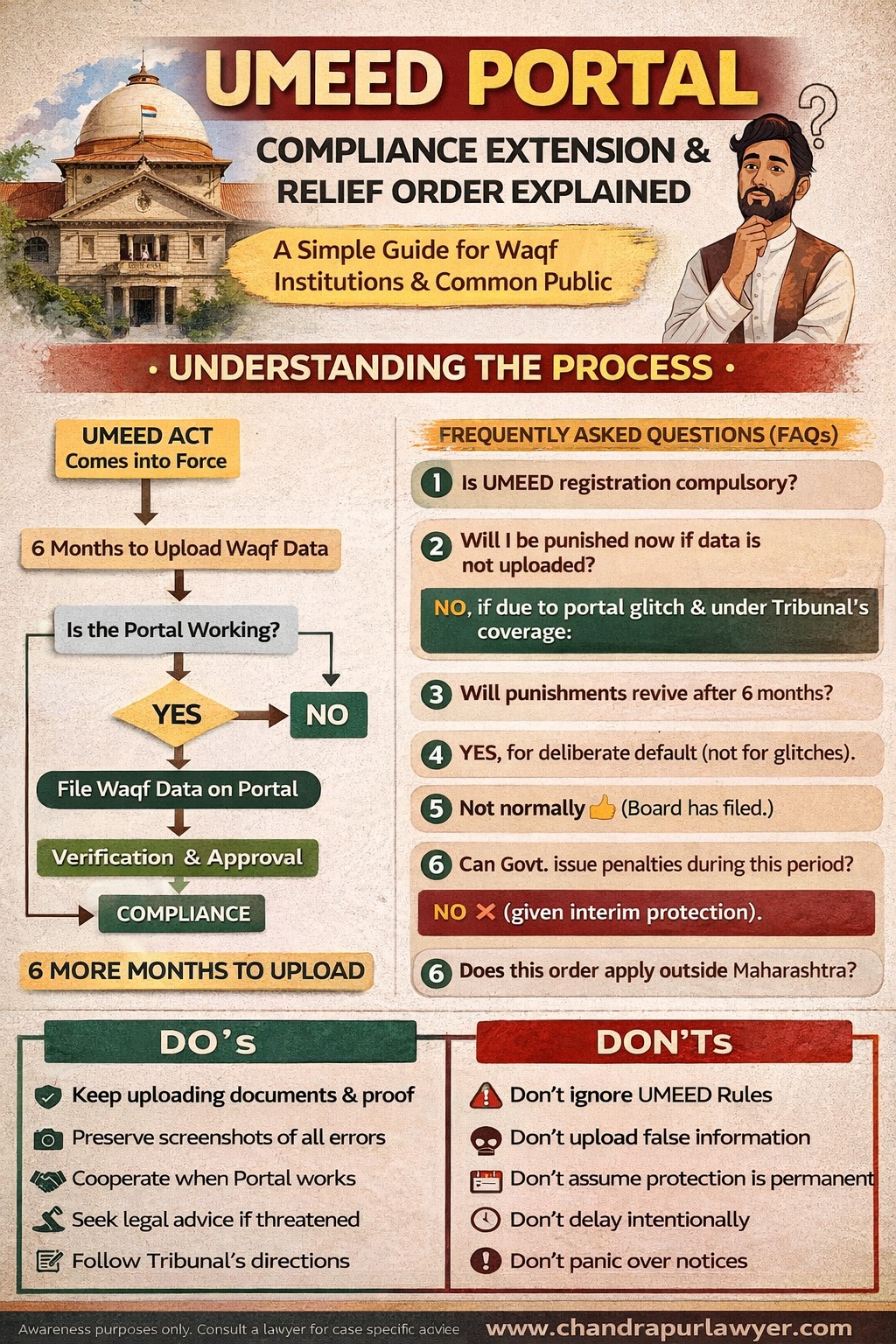
1. Introduction: Why This Order Became Necessary
In 2025, a major change was introduced in the governance of Waqf properties through the Unified Waqf Management, Empowerment, Efficiency and Development Act, 2025, commonly known as the UMEED Act.
While the objective was transparency and accountability, the sudden implementation of mandatory digital compliance created serious practical difficulties for Waqf institutions across Maharashtra.
Recognising the gravity of the situation, the Maharashtra State Waqf Tribunal granted interim relief, protecting thousands of institutions from penal consequences caused by persistent portal failures.
2. What Is the UMEED Act and the UMEED Portal?
- Centralised digital record keeping of Waqf properties
- Prevention of misuse and encroachment
- Improved governance through technology
The UMEED Portal requires multi-level verification involving upload, checking, and approval of data.
3. Legal Obligation Under Section 3B
- Six months time to upload Waqf data
- Tribunal empowered to extend time by six months
- Penalties apply only for deliberate non-compliance
4. Penalties Under the Law
- Imprisonment up to six months
- Fine ranging from ₹20,000 to ₹1,00,000
5. Ground Reality in Maharashtra
- Over 36,000 registered Waqf institutions
- Approximately 75,000 data entries required
- Massive technical failures prevented compliance
6. Tribunal’s Finding on Delay
The Tribunal categorically held that the delay was not intentional and occurred solely due to persistent technical failures of the portal.
7. Power of the Waqf Tribunal
- Statutory power under Section 3B
- Supreme Court directions
- Principle of natural justice
8. Relief Granted by the Tribunal
- Extension of time for compliance
- Protection from penal action
- Directions to rectify portal defects
9. What the Order Does Not Do
- Does not cancel the UMEED Act
- Does not grant permanent exemption
- Does not permit indefinite delay
10. DO’s and DON’Ts
| DO’s | DON’Ts |
|---|---|
| Maintain property documents | Do not ignore compliance obligations |
| Record portal errors | Do not rely on rumours |
| Cooperate with Waqf Board | Do not upload false data |
15. Conclusion
The Maharashtra State Waqf Tribunal’s order restores balance between law and reality. It ensures that penal law is not enforced blindly and that compliance follows functionality.
The message is clear: comply with the law, but only after the State makes compliance possible.
This article is for public awareness and educational purposes only and does not constitute legal advice. For case-specific guidance, consult a qualified advocate.