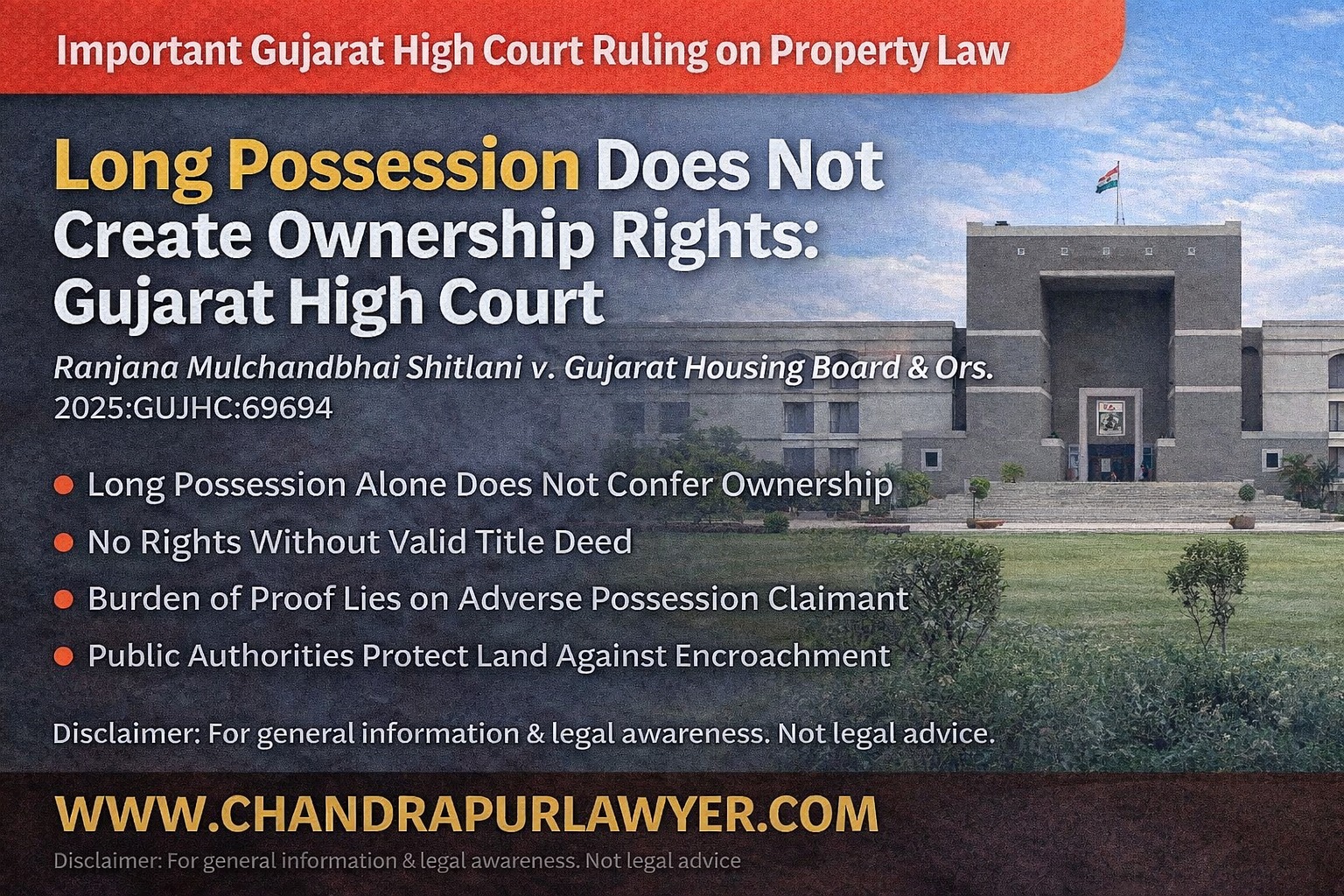
Case Title: Ranjana Mulchandbhai Shitlani vs Gujarat Housing Board & Ors.
Citation: 2025:GUJHC:69694
Decision Year: 2025
Subject: Property Law | Adverse Possession | Public Authority Land
Platform: ChandrapurLawyer.com
Authored By:
Adv. Mohammad Nazim Khan
Advocate & Legal Researcher
Introduction: A Common Belief, Firmly Rejected by Law
In a significant judgment reaffirming settled principles of property law, the Gujarat High Court has categorically held that long or continuous possession of land does not, by itself, create ownership rights, particularly when the land belongs to a statutory or public authority.
The ruling came in Ranjana Mulchandbhai Shitlani vs Gujarat Housing Board & Ors. (2025:GUJHC:69694), where the petitioner claimed ownership and protection against eviction primarily on the ground of long-standing possession.
Rejecting the plea, the High Court ruled that possession without legal title remains possession only and cannot mature into ownership unless strict legal requirements—such as adverse possession—are conclusively proved.
Background of the Dispute
The petitioner challenged actions initiated by the Gujarat Housing Board, a statutory authority, claiming long, peaceful, and uninterrupted possession of the disputed land.
- Continuous possession for several decades
- Open and uninterrupted occupation
- Claim for protection against eviction
The Housing Board countered that the land was public property and that the petitioner had no document of title, allotment, lease, or sale deed.
Core Legal Issue Before the Court
Does long possession of land, without valid title, create ownership or enforceable rights against the lawful owner, particularly a public authority?
Understanding the Difference: Possession vs Ownership
The Court reiterated the fundamental distinction between possession and ownership.
- Possession – physical control over property
- Ownership – legal title conferring rights to use, enjoy, transfer, and exclude
Confusing possession with ownership, the Court observed, leads to serious legal errors.
Petitioner’s Arguments
- Long duration of possession should create rights
- Earlier inaction by the authority implied acquiescence
- Equitable relief due to hardship
- Implied entitlement from long occupation
Stand of the Gujarat Housing Board
- The land is public property
- No title documents exist in petitioner’s favour
- The petitioner is an unauthorised occupant
- Equity cannot defeat statutory ownership
Gujarat High Court’s Analysis and Findings
1. Long Possession Does Not Create Ownership
The Court categorically held that long possession, however continuous, does not confer ownership unless it ripens into adverse possession in accordance with law.
2. Adverse Possession Is Not Automatic
To succeed in adverse possession, a claimant must prove:
- Hostile possession against the true owner
- Open and notorious occupation
- Continuous possession for the statutory period
- Knowledge of the true owner
The burden of proof lies entirely on the claimant, which was not discharged in this case.
3. No Easy Adverse Possession Against Public Authorities
Claims against government or statutory bodies are scrutinised more strictly, as public land is held in trust for society.
4. Equity Cannot Override Law
The Court rejected sympathy-based pleas, holding that equity follows the law and cannot legalise unauthorised occupation.
5. Delay by Authorities Does Not Confer Rights
Mere delay or inaction by a public authority does not amount to transfer of ownership or creation of legal rights.
Judgment Outcome
- Petition dismissed
- No ownership or possessory right recognised
- Authority of Gujarat Housing Board upheld
Why This Judgment Is Important
- Reinforces rule of law in property disputes
- Protects public land from encroachments
- Dispels myths around long possession
- Restricts misuse of writ jurisdiction
Impact on Future Property Litigation
The ruling will significantly influence disputes involving encroachments, adverse possession claims, and challenges against housing boards and development authorities.
Conclusion: Possession Without Title Is a Weak Shield
The Gujarat High Court’s ruling is a timely reminder that ownership flows from law, not occupation. Possession may offer limited protection in rare cases, but it cannot replace legal title, especially against public authorities.
This article is published on ChandrapurLawyer.com for general legal awareness and informational purposes only. It does not constitute legal advice or create a lawyer-client relationship. Readers are advised to consult a qualified legal professional before acting on the information. The views expressed are personal to the author.