Bench: Justice Sanjay Kumar & Justice Alok Aradhe
Decision Date: December 2025
Subject: Administrative Law | Government Policy | Article 14 | Public Governance
Platform: ChandrapurLawyer.com
Authored By:
Adv. Mohammad Nazim Khan
Advocate & Legal Researcher
Introduction: When Policy Becomes a Binding Promise
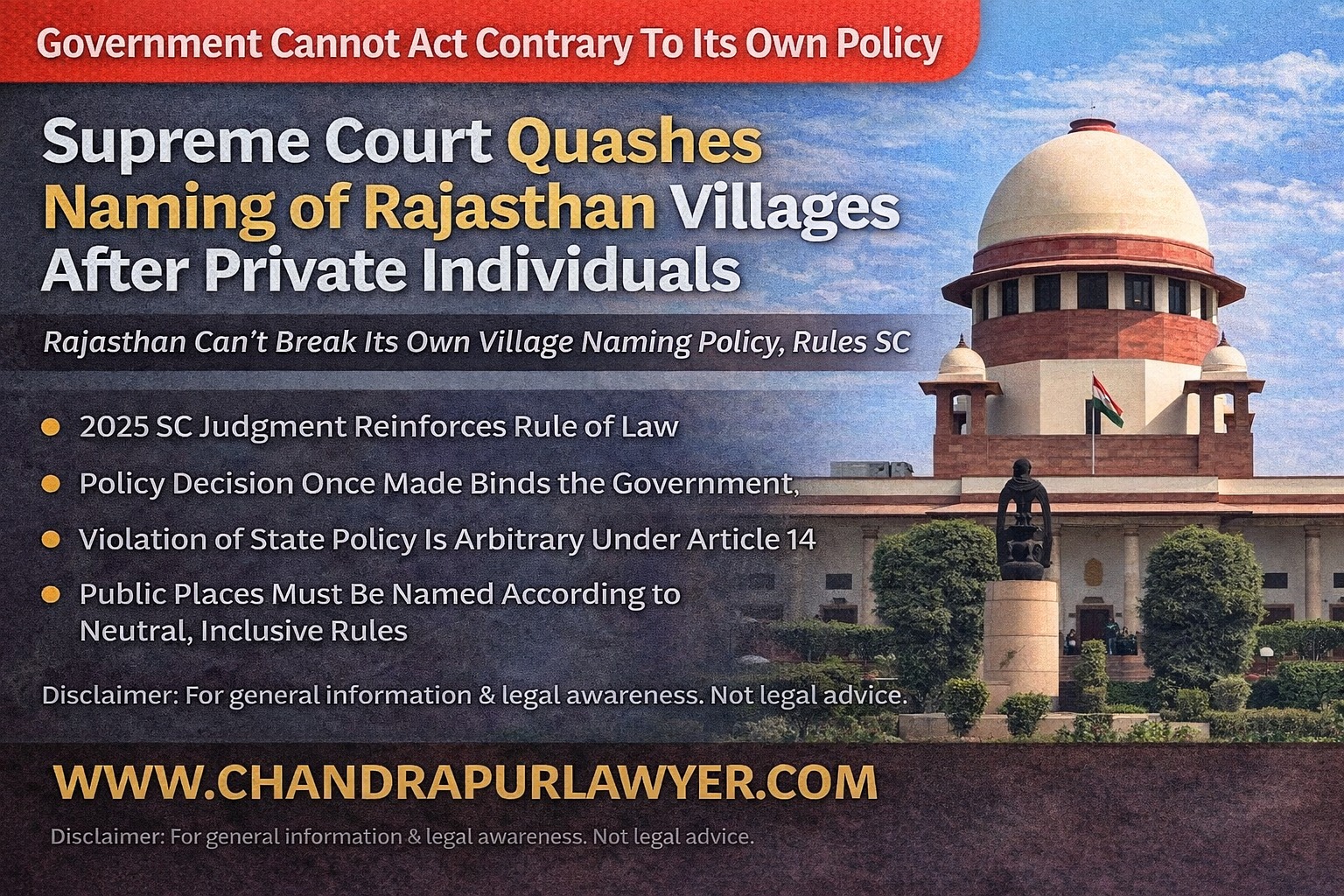
In a landmark ruling reinforcing the rule of law in governance, the Supreme Court of India has held that a government cannot act contrary to its own declared policy. Any such action, the Court held, is arbitrary, unconstitutional, and liable to be struck down.
The Court quashed the Rajasthan Government’s decision to name certain revenue villages after private individuals, holding that the action violated a binding State policy that expressly prohibited naming villages after individuals, castes, religions, or communities.
This judgment is not merely about village names. It is a far-reaching pronouncement on administrative discipline, constitutional equality, and the limits of executive discretion.
Why This Judgment Matters
- Curbs arbitrary government action
- Reinforces policy consistency
- Strengthens Article 14 (Equality before Law)
- Prevents misuse of power under personal or political influence
- Affirms that government policies are binding, not optional
Factual Background: How the Dispute Arose
Creation of New Revenue Villages
In December 2020, the Government of Rajasthan issued a notification under Section 16 of the Rajasthan Land Revenue Act, 1956, creating several new revenue villages in Barmer district.
Among them were villages named Amargarh and Sagatsar, named after private individuals who had donated land for village formation.
Why the Naming Was Challenged
- The State had a binding policy dated 20 August 2009
- The policy prohibited naming villages after individuals
- Such naming violated constitutional equality
- It encouraged personal glorification in public governance
The 2009 Rajasthan Government Policy
The core dispute revolved around a government circular dated 20 August 2009, which laid down that revenue villages shall not be named after individuals, caste, sub-caste, religion, or community.
The policy aimed to ensure neutrality, inclusiveness, and avoidance of state-sponsored personal glorification.
Conflicting High Court Decisions
Single Judge of Rajasthan High Court
The Single Judge quashed the naming, holding that the policy was binding and the government’s action violated Article 14.
Division Bench Reverses the Order
The Division Bench later reversed the decision, holding that the policy was directory and that the State had discretion under the Land Revenue Act.
Key Legal Question Before the Supreme Court
Can a government act in violation of its own declared policy without amending or withdrawing it?
Supreme Court’s Analysis: Policy Is Not a Suggestion
1. Government Policy Has Binding Force
The Supreme Court categorically held that once a policy is framed and notified, the Government is bound by it. Policies govern executive conduct unless lawfully modified.
2. Government Cannot Pick and Choose
Selective application of policy violates Article 14, encourages arbitrariness, and undermines public trust.
3. Violation of Policy Equals Arbitrary Action
Acting contrary to policy without amendment is inherently arbitrary. Arbitrariness, the Court reiterated, is the antithesis of equality.
4. Policy Must Be Amended, Not Ignored
If the Government intended to permit naming villages after individuals, it was required to formally amend the 2009 policy and apply it uniformly. Ignoring policy without amendment is Final impermissible.
Article 14: Equality as the Constitutional Backbone
Public naming affects collective identity. Unequal or selective naming creates preferential treatment and lacks rational classification, violating equality before law.
Public Land, Public Identity
The Supreme Court emphasised that public entities must reflect public character, not private recognition. Naming villages after individuals blurs public-private boundaries and encourages patronage.
Final Outcome
- Division Bench judgment set aside
- Single Judge’s order restored
- Naming of villages after individuals quashed
Wider Legal Principles Reaffirmed
- Executive must act within self-imposed limits
- Rule of law prevails over executive convenience
- Public power is a trust held for the people
Why This Judgment Has National Significance
The ruling impacts naming of public places, administrative discretion, and judicial review of policy violations across India.
Explainer: When Can Government Deviate from Policy?
- Policy must be formally amended
- Change must be notified
- Reasonable justification must exist
- Change must apply uniformly
Conclusion: Policy Is a Promise, Not a Preference
By holding that the government cannot act contrary to its own policy, the Supreme Court has strengthened rule of law, curtailed arbitrariness, and reinforced administrative accountability.
In a democracy, government policy is not optional. It is a binding promise to the people.
This article is published on ChandrapurLawyer.com for general legal awareness and informational purposes only. It does not constitute legal advice. Readers are advised to consult qualified legal professionals for advice specific to their facts and circumstances. The views expressed are personal to the author.