Introduction
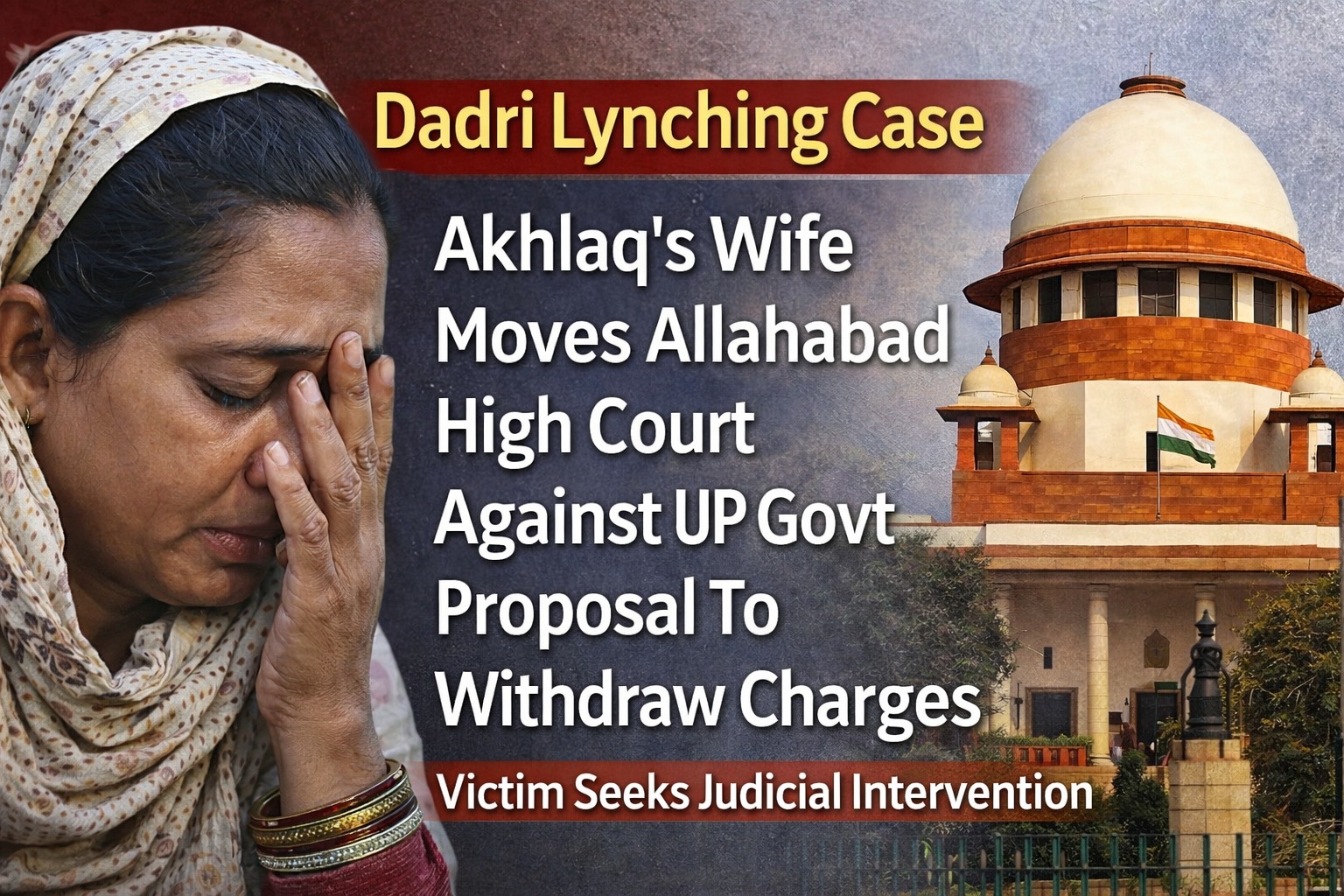
In a significant legal development in the long-running 2015 Dadri lynching case, the wife of lynching victim Mohammad Akhlaq has approached the Allahabad High Court challenging the Uttar Pradesh government’s attempt to withdraw criminal prosecution against the accused.
The petition raises critical constitutional and criminal jurisprudence issues concerning the limits of executive power in criminal prosecutions and the rights of victims to seek justice in serious offences.
Background: The Dadri Lynching Tragedy
On 28 September 2015, Mohammad Akhlaq, a resident of Bisada village in Greater Noida, was beaten to death by a mob on suspicion of possessing and consuming beef. The incident triggered nationwide outrage and debate on mob violence and communal vigilantism.
An FIR was registered under multiple provisions of the Indian Penal Code, including murder, attempt to murder, rioting, and unlawful assembly. Eighteen accused were arrested, including minors.
State’s Attempt to Withdraw Prosecution
In October 2025, the Uttar Pradesh government moved an application under Section 321 of the Code of Criminal Procedure seeking withdrawal of prosecution against the accused.
The stated grounds included alleged inconsistencies in witness statements and absence of certain weapons. The victim’s family opposed this move, contending that it lacked legal justification.
High Court Challenge by Akhlaq’s Wife
Akhlaq’s wife has filed a writ petition before the Allahabad High Court challenging the government order directing withdrawal, the consequential prosecutorial actions, and the application under Section 321 CrPC.
The petition asserts that executive discretion in serious criminal cases must conform to constitutional principles and cannot override victims’ rights.
Section 321 CrPC and Judicial Scrutiny
Withdrawal of prosecution under Section 321 CrPC requires consent of the trial court. Courts must independently assess whether such withdrawal would result in a miscarriage of justice.
Trial Court Rejects Withdrawal Plea
The trial court rejected the State’s application, holding that it lacked legal basis and directed the trial to proceed on a day-to-day basis with witness protection measures.
Victim Family’s Stand and Public Interest
The victim’s family has consistently maintained that withdrawal of prosecution in a mob lynching case would erode public confidence in the criminal justice system.
Constitutional and Legal Implications
- Limits on executive discretion in criminal prosecution
- Recognition of victims as stakeholders in criminal proceedings
- Judicial duty to prevent miscarriage of justice
Conclusion
With the trial court rejecting the withdrawal plea and the High Court now seized of the challenge, the judiciary remains central to ensuring that justice follows due process. The outcome will significantly shape jurisprudence on prosecutorial discretion and victims’ rights in India.
This article is for informational and academic purposes only and does not constitute legal advice. The views expressed are personal.