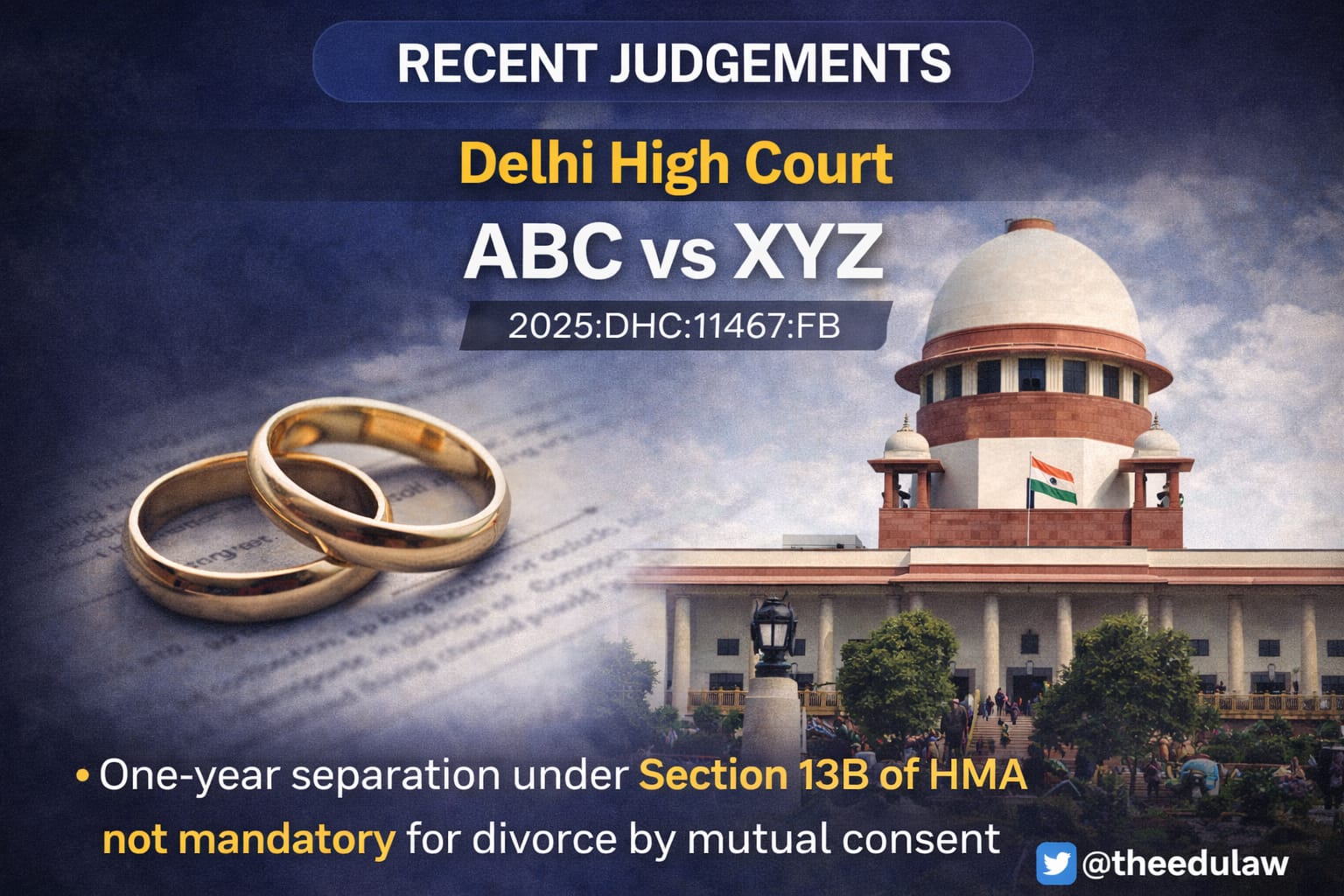
ABC vs XYZ
(2025: DHC: 11467 : FB)
Introduction
In a landmark judgment bringing much-needed clarity to matrimonial jurisprudence, the Full Bench of the Delhi High Court has held that one-year separation is not a mandatory pre-condition for granting divorce by mutual consent under Section 13B of the Hindu Marriage Act, 1955.
The decision resolves long-standing confusion arising from divergent judicial interpretations and reaffirms that procedural timelines under Section 13B are directory, not mandatory, where the marriage has irretrievably broken down and consent is genuine.
The ruling strengthens the evolving judicial approach that matrimonial law must be applied with pragmatism, compassion, and constitutional sensitivity rather than rigid technicality.
Background: Section 13B and the Question of Separation
Section 13B of the Hindu Marriage Act provides for divorce by mutual consent and was introduced recognising that forcing parties to remain in a broken marriage serves no social or legal purpose.
Traditionally, Section 13B(1) requires that the parties:
- Have been living separately for a period of one year or more;
- Have not been able to live together;
- Have mutually agreed that the marriage should be dissolved.
This is followed by a cooling-off period under Section 13B(2). Over time, courts differed on whether the one-year separation requirement was absolute or flexible.
The Reference to the Full Bench
Conflicting decisions by coordinate benches of the Delhi High Court created uncertainty on whether one-year separation was a jurisdictional requirement.
Given the recurring nature of the issue, the matter was referred to a Full Bench for authoritative determination.
Whether the requirement of one-year separation under Section 13B(1) is mandatory, or whether courts can grant divorce by mutual consent even before completion of such period.
Facts in Brief
In ABC vs XYZ, the parties soon realised that their marriage was unworkable. Despite attempts at reconciliation, the relationship deteriorated beyond repair.
Both spouses voluntarily agreed to dissolve the marriage, settled all ancillary issues, and approached the Family Court seeking divorce by mutual consent. Objections arose solely on the ground that one year had not elapsed.
Interpretation of “Living Separately”
The Full Bench held that physical separation for a fixed period is not the sole indicator of marital breakdown.
- Parties may live under the same roof yet be matrimonially separated;
- Separation lies in cessation of marital obligations;
- Rigid timelines ignore lived realities of relationships.
Legislative Intent Behind Section 13B
Tracing legislative history, the Court noted that Section 13B was enacted to enable dignified exits from dead marriages, reduce bitterness, and promote amicable resolution.
Directory vs Mandatory: Legal Analysis
The Court reiterated that mandatory provisions invalidate proceedings upon non-compliance, while directory provisions permit discretion where no prejudice is caused.
- No penal consequence is prescribed for non-compliance with the one-year period;
- The provision is procedural in nature;
- Courts retain discretion to assess marital breakdown.
Reliance on Supreme Court Precedents
The Full Bench relied on progressive Supreme Court decisions including:
- Amardeep Singh v. Harveen Kaur (waiver of cooling-off period);
- Naveen Kohli v. Neelu Kohli (irretrievable breakdown);
- Shilpa Sailesh v. Varun Sreenivasan (constitutional autonomy).
Constitutional Perspective
Invoking Article 21, the Court held that dignity includes the right not to be trapped in a dysfunctional marriage. Procedural rigidity cannot override personal autonomy.
Family Courts and Judicial Discretion
Family Courts must examine whether consent is genuine, reconciliation has failed, and whether continuation of marriage serves any purpose. Mechanical application of timelines is discouraged.
Safeguards Against Misuse
- Absence of coercion or fraud;
- Complete settlement of disputes;
- Informed and voluntary consent.
Impact on Matrimonial Litigation
- Timely relief to litigants in dead marriages;
- Reduction in prolonged litigation and emotional distress;
- Uniformity and clarity in application of law;
- Alignment with contemporary social realities.
Ratio Decidendi
The requirement of one-year separation under Section 13B(1) of the Hindu Marriage Act is directory and not mandatory, and courts may grant divorce by mutual consent even before completion of one year where the marriage has irretrievably broken down.
Conclusion
The Full Bench decision in ABC vs XYZ marks a significant milestone in Indian matrimonial jurisprudence. By prioritising dignity, autonomy, and justice over procedural rigidity, the Delhi High Court has reaffirmed that law must serve human realities.
The judgment stands as a reminder that compassion is not antithetical to law; it is its highest expression.