Introduction
After a series of landmark rulings strengthening gender equality and women’s property rights, the Supreme Court of India has delivered a judgment that has sparked significant legal and social debate.
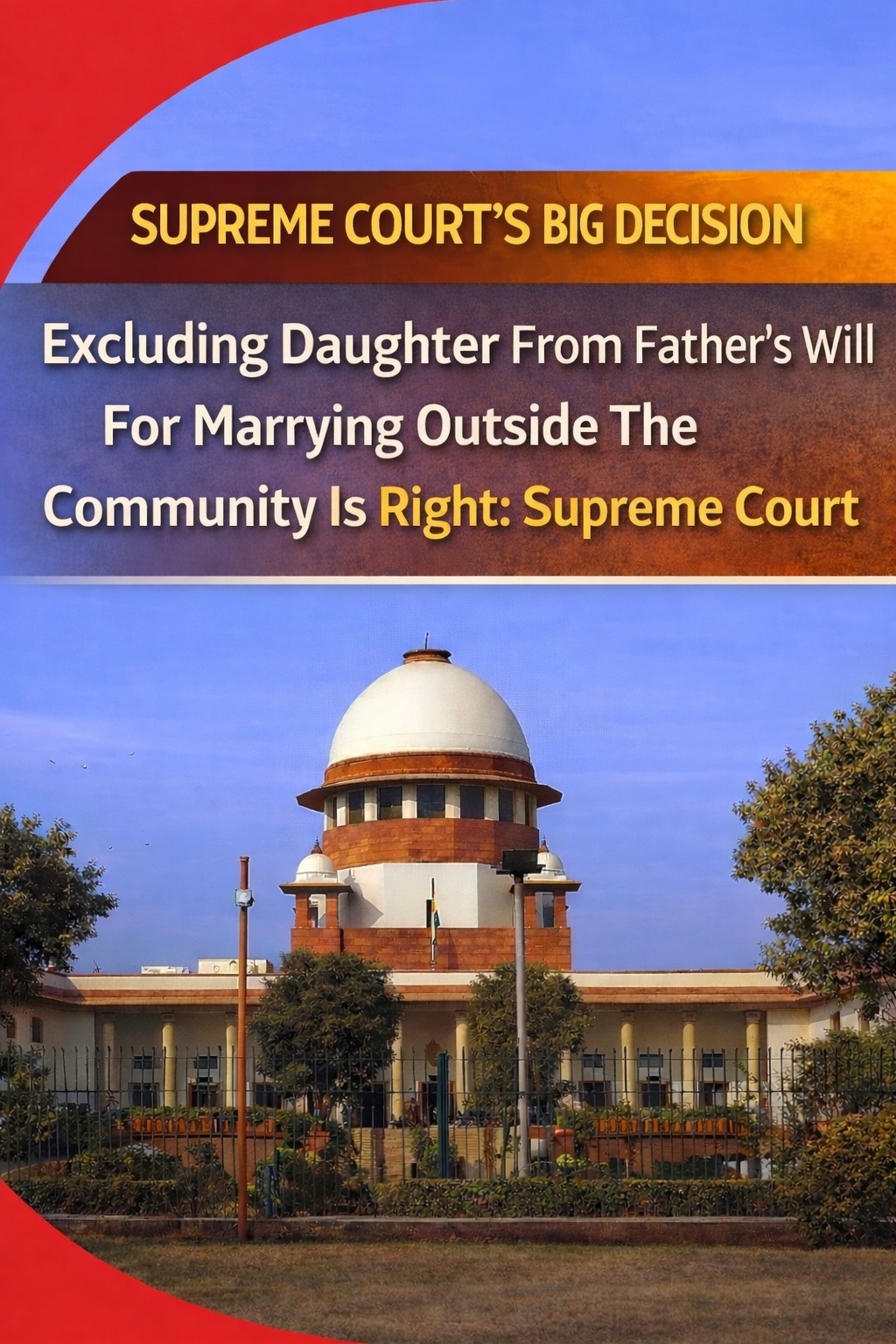
In a case concerning testamentary succession, the apex court upheld a father’s will excluding one of his daughters from inheritance on the ground that she had married outside her community.
Reversing the findings of both the Trial Court and the High Court, the Supreme Court reaffirmed the principle of absolute testamentary freedom under Indian succession law.
Factual Background of the Case
The dispute arose from the will executed by N. S. Sridharan, who had nine children, including one daughter, Shaila Joseph. The will expressly excluded her from inheritance on the stated ground that she had married outside the community.
The Trial Court and the High Court questioned the genuineness of the will and directed equal distribution among all nine children. The beneficiaries under the will challenged these findings before the Supreme Court.
Key Legal Question Before the Supreme Court
Whether a testator has the legal right to exclude a legal heir from inheritance through a valid will, even if the reason for exclusion is personal, social, or community-based.
Supreme Court’s Ruling
- A testator has absolute freedom to dispose of self-acquired property through a will
- Courts cannot substitute moral or social notions for testamentary intent
- Exclusion of a legal heir does not invalidate a lawful will
Testamentary Freedom Under Indian Law
The Court reiterated that Indian succession law does not recognise compulsory inheritance. A legal heir has no vested right in property during the lifetime of the testator.
Why the High Court’s Reasoning Failed
- Inequality alone does not render a will suspicious
- Moral reasoning cannot replace legal reasoning
- Gender equality principles do not override testamentary autonomy
Marriage Outside Community: Legal Position
The Supreme Court clarified that the motivation behind exclusion is legally irrelevant so long as the will is validly executed and proved. Courts cannot judge personal beliefs or preferences of a testator.
Proof of Will: Reaffirmed Principles
- Proper execution and attestation
- Absence of coercion or undue influence
- Mental capacity of the testator
Broader Implications
The ruling reinforces will-writing autonomy and places clear limits on judicial interference in testamentary matters.
Conclusion
By upholding the will despite exclusion of a daughter, the Supreme Court has drawn a clear legal boundary between inheritance by law and inheritance by choice. Equality governs intestate succession, not testamentary disposition.
Citation:
Supreme Court of India, Testamentary Succession
Judgment on exclusion of daughter from will on grounds of inter-community marriage
This article is for informational purposes only and does not constitute legal advice. The views expressed are personal to the author.