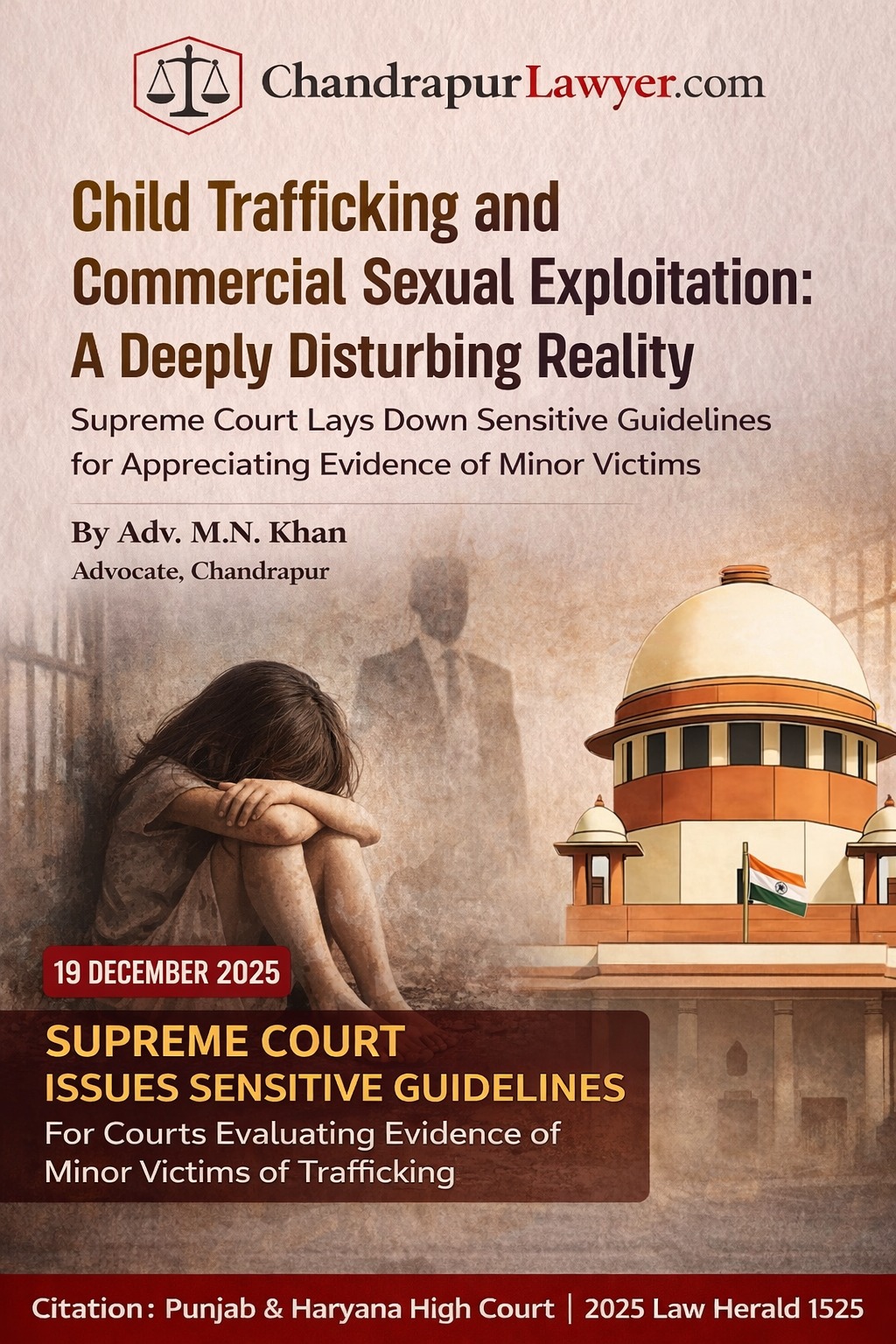
Child Trafficking and Commercial Sexual Exploitation: A Deeply Disturbing Reality
Introduction
Calling child trafficking and commercial sexual exploitation a deeply disturbing reality in India, the Supreme Court of India has once again foregrounded the urgent need for a victim-centric, humane, and legally sensitive approach while adjudicating cases involving minor victims.
In its judgment delivered on Friday, December 19, the apex court laid down detailed guidelines directing courts on how the evidence of child victims must be appreciated, evaluated, and understood.
The Court issued a clear caution against rejecting testimony merely due to minor inconsistencies, delays, or stereotypical expectations of conduct, recognising that child victims operate under coercion, fear, trauma, and systemic abuse.
Child Trafficking in India: The Grim Context
Child trafficking remains one of the gravest human rights violations in India. Children continue to be trafficked for:
- Commercial sexual exploitation
- Forced labour
- Domestic servitude
- Begging rackets
- Illegal adoption networks
The Supreme Court observed that trafficking networks thrive on poverty, social exclusion, gender discrimination, and lack of institutional safeguards.
Legal Question Before the Supreme Court
The core issue before the Court was how evidence of minor victims should be appreciated when testimony contains inconsistencies or does not conform to conventional expectations of conduct.
Supreme Court’s Observations: A Victim-Centric Lens
1. Minor Inconsistencies Are Natural
The Court clarified that trauma-induced inconsistencies are natural outcomes of prolonged abuse and psychological stress, and cannot be treated as fatal to credibility.
2. Stereotypical Notions Must Be Rejected
- Silence does not imply consent
- Delay does not imply falsehood
- Continued presence does not imply voluntariness
3. Trafficking Operates Through Coercive Control
The Court acknowledged that trafficking is a continuing crime sustained by threats, violence, manipulation, and economic dependence.
Appreciation of Evidence: Judicial Guidelines
- Evidence must be read holistically
- Trauma-induced inconsistencies should be expected
- Victim blaming must be avoided
- Power imbalance must be recognised
- Corroboration should not be insisted upon as a rule
- Judicial empathy must guide proceedings
International and Constitutional Perspective
The judgment draws strength from Article 21 of the Constitution and aligns Indian jurisprudence with international instruments protecting child rights and trafficking victims.
Impact on Criminal Justice System
The ruling is likely to influence trial court adjudication, appellate scrutiny, prosecution strategies, and judicial training in trafficking cases.
Conclusion
By calling child trafficking a deeply disturbing reality, the Supreme Court has delivered a judgment rooted in empathy and constitutional conscience. Survivors are not unreliable witnesses, but voices that must be heard with dignity and care.
Citation:
Supreme Court of India, Judgment dated 19 December 2025
Child Trafficking and Commercial Sexual Exploitation, Appreciation of Evidence
This article is intended for informational and academic purposes only and does not constitute legal advice. The views expressed are personal to the author.