New Delhi | Environmental & Constitutional Law
Supreme Court of India | Forest Protection & State Accountability
Introduction: Judicial Alarm Over Environmental Destruction
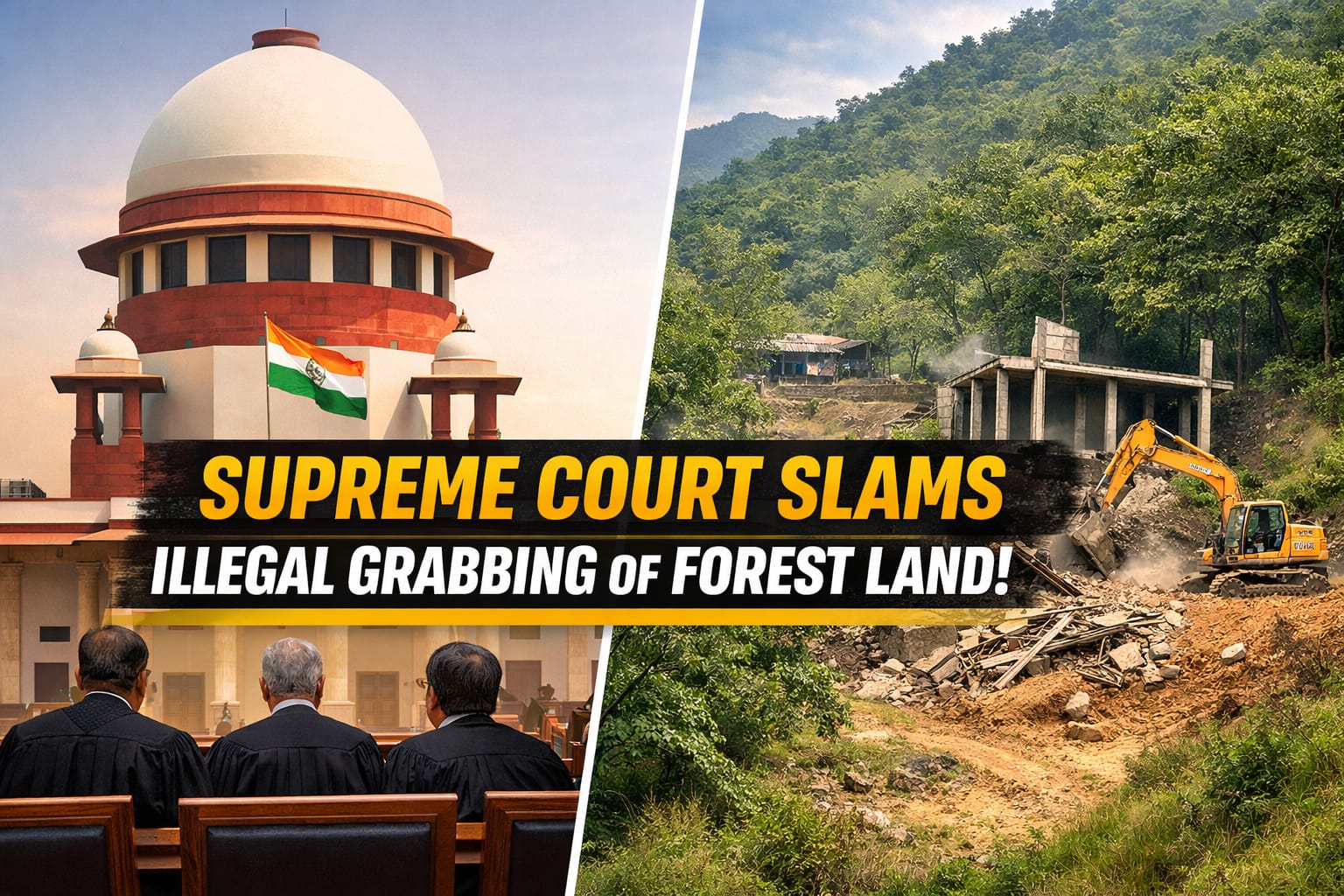
In a stern and strongly worded observation, the Supreme Court of India has expressed deep concern over large-scale encroachment and illegal occupation of forest land in the State of Uttarakhand. Describing the situation as “shocking”, the Court observed that authorities appeared to be sitting as silent spectators while forest land was being systematically grabbed in front of their eyes.
The remarks were made during proceedings examining allegations of organised encroachment on forest land by private individuals and entities, coupled with alleged administrative inaction by statutory authorities entrusted with the duty to protect forest resources.
The observations reflect a growing judicial unease with environmental degradation enabled not only by private actors, but also by institutional apathy and administrative failure.
Background: Allegations of Rampant Encroachment
The matter arose from reports and material placed before the Supreme Court indicating that substantial tracts of forest land in Uttarakhand were being encroached upon, converted, and utilised for non-forest purposes without lawful authority.
The Court was informed that:
- Forest land was being occupied in a systematic manner
- Unauthorised constructions were coming up on such land
- Third-party rights were allegedly being created
- Despite awareness, local and state authorities failed to take effective action
These circumstances compelled the Court to scrutinise not only the actions of encroachers, but also the conduct of government officials and forest authorities responsible for safeguarding public and environmental assets.
Supreme Court’s Strong Observations
The Supreme Court did not mince words while addressing the issue. Expressing shock at the prevailing situation, the Court remarked that forest land was being unlawfully occupied in full public view while authorities remained mute onlookers.
The Court noted that violations of such magnitude could not occur without either active collusion or gross negligence on the part of enforcement agencies. It emphasised that forest land is not merely government property, but a national and ecological asset deserving the highest degree of protection.
Accountability of State Authorities
A central focus of the Court’s scrutiny was the role of state authorities. The Supreme Court made it clear that:
- Forest and revenue authorities have a statutory duty to prevent encroachment
- Administrative excuses cannot justify prolonged inaction
- Failure to act amounts to abdication of constitutional responsibility
The Court’s reasoning reinforces that environmental governance is not a discretionary function, but a binding constitutional obligation flowing from Articles 48A and 51A(g) of the Constitution.
Directions Issued by the Supreme Court
To address the gravity of the situation, the Supreme Court issued several directions, including:
- Calling upon senior administrative and forest officials to explain enforcement failures
- Directing the constitution of a fact-finding or enquiry mechanism
- Restraining further creation of third-party rights on disputed forest land
- Ensuring protection of vacant forest land from further encroachment
These directions indicate a judicial intent to secure meaningful corrective action rather than symbolic compliance.
Environmental Jurisprudence and the Public Trust Doctrine
The Court’s intervention is firmly rooted in established principles of Indian environmental jurisprudence. Forests are held by the State in public trust for present and future generations, and failure to protect them undermines sustainable development and inter-generational equity.
Judicial precedent has consistently recognised that:
- Forest land cannot be diverted except in accordance with law
- Environmental protection forms an integral part of the right to life under Article 21
- State authorities act as trustees, not owners, of natural resources
The present observations reaffirm these principles in clear and uncompromising terms.
Broader Implications of the Order
For State Governments
The ruling sends a strong warning that environmental inaction will invite judicial scrutiny and that passive administration will not be tolerated.
For Forest and Revenue Authorities
Officials responsible for protecting forest land may be required to account personally for lapses, particularly where encroachments occur openly and over extended periods.
For Private Encroachers
The Court’s observations make it clear that illegal occupation of forest land, even if longstanding, does not acquire legitimacy and may invite eviction, demolition, and legal consequences.
Judicial Concern Over the Normalisation of Encroachment
One of the most troubling aspects highlighted by the Court is the apparent normalisation of forest encroachment. The observation that such grabbing is occurring “in front of their eyes” reflects deep judicial concern over how environmental violations are increasingly treated as routine or inevitable.
The Supreme Court’s intervention seeks to disrupt this dangerous complacency and restore accountability.
Conclusion
The Supreme Court’s strong remarks against administrative silence in the face of forest land encroachment mark a significant moment in environmental enforcement jurisprudence. By calling out not only violators but also regulators, the Court has reinforced the principle that environmental protection begins with accountability.
The message is unequivocal: forest land is not expendable, and those entrusted with its protection cannot remain spectators to its destruction.