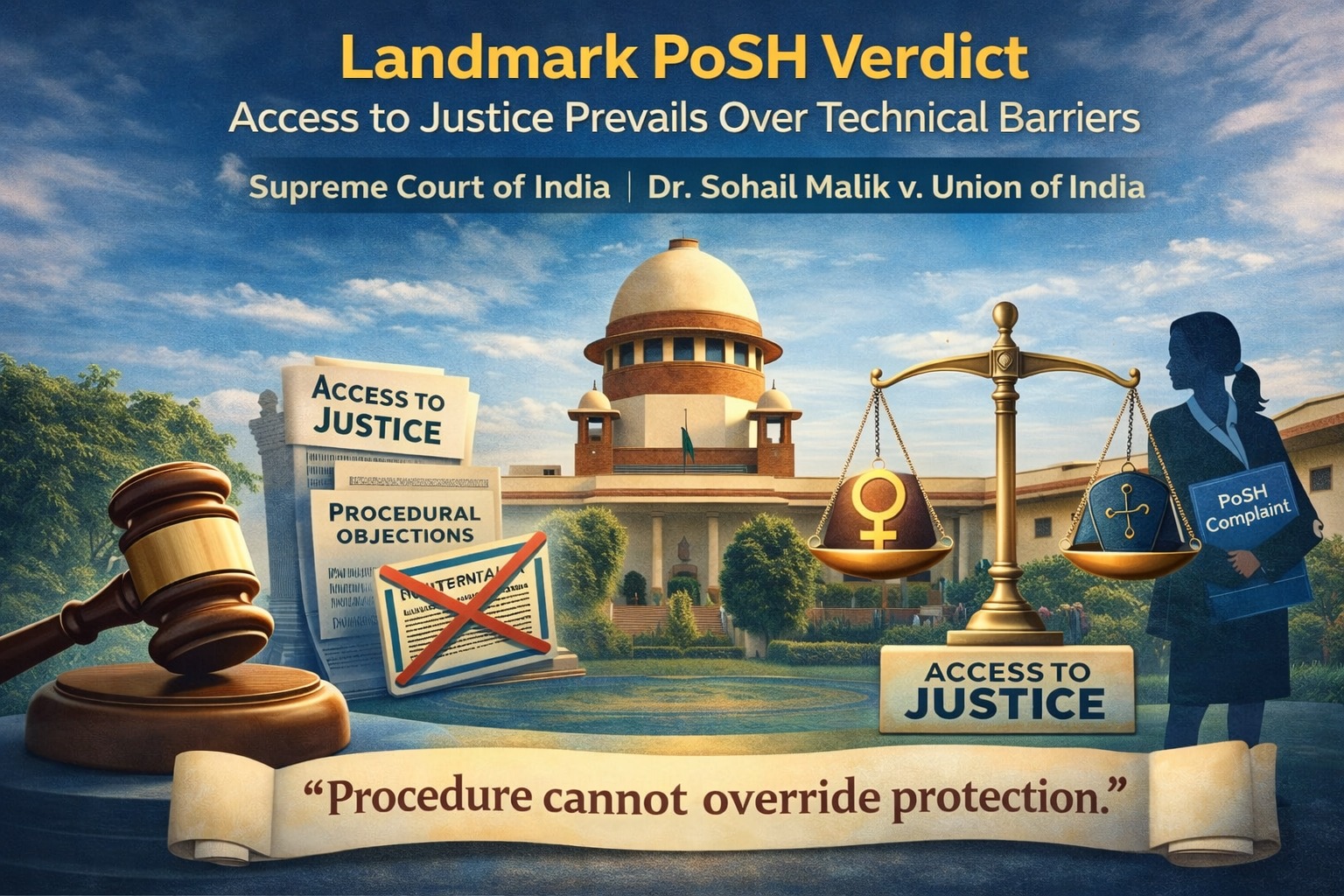
Supreme Court of India | Landmark PoSH Clarification
Dr. Sohail Malik v. Union of India
Decision dated: 10 December 2025
Author
Adv. Nazim Khan
PoSH Practitioner
Advocate & Legal Consultant
(Workplace Sexual Harassment Law, Compliance & Advisory)
I. Introduction
The Sexual Harassment of Women at Workplace (Prevention, Prohibition and Redressal) Act, 2013 (PoSH Act) was enacted as a remedial statute rooted in constitutional guarantees of equality, dignity, and a safe working environment. Over a decade since its enactment, courts have been repeatedly called upon to clarify whether PoSH should function as a protective framework or be reduced to a procedural compliance mechanism.
In a significant pronouncement delivered on 10 December 2025, the Supreme Court of India reaffirmed that access to justice under the PoSH regime cannot be curtailed by technical or jurisdictional objections. The Court clarified that a woman is entitled to file a PoSH complaint before the Internal Complaints Committee (ICC) of her own workplace even where the respondent is employed in a different organisation or department.
This ruling consolidates PoSH jurisprudence by firmly placing substance over form and protection over procedure.
II. Background: Evolution of the PoSH Framework in India
A. Constitutional and International Foundations
The PoSH Act is not a standalone legislative instrument. Its foundations lie in Articles 14, 15, and 21 of the Constitution of India, India’s obligations under the Convention on the Elimination of All Forms of Discrimination Against Women (CEDAW), and the landmark Vishaka v. State of Rajasthan judgment, which recognised workplace sexual harassment as a violation of fundamental rights.
The Vishaka Guidelines were framed to ensure immediate access to remedies pending legislative enactment. This philosophy of accessibility and protection was later codified in the PoSH Act.
B. Legislative Intent of the PoSH Act, 2013
- Prevention of sexual harassment
- Redressal through accessible internal mechanisms
- Employer responsibility
- Speedy and non-intimidating processes
Importantly, ICCs are not conceived as courts of strict jurisdiction but as facilitative bodies meant to enable redressal.
III. The Practical Problem: Jurisdictional and Cross-Entity Complaints
Despite the remedial intent of the statute, implementation challenges emerged. One recurring issue has been cross-entity complaints where the complainant and respondent are employed in different organisations or where incidents arise during work-related interactions.
- Respondent not employed with the organisation
- Incident outside organisational control
- Complaint redirected to respondent’s ICC
Such objections often resulted in denial of effective remedies and fragmented access to justice.
IV. The Supreme Court’s Clarification: Core Holding
In Dr. Sohail Malik v. Union of India, the Supreme Court decisively addressed this issue.
- A woman may file a PoSH complaint before the ICC of her own workplace.
- This right subsists even if the respondent is employed in a different organisation.
- Procedural or technical objections cannot defeat the protective purpose of the PoSH law.
The Court reaffirmed that procedure cannot override protection.
V. Interpretation of ICC Jurisdiction: Facilitative, Not Restrictive
A. ICC as a Protective Mechanism
- In-house grievance redressal mechanism
- Designed for immediate access
- Minimal formality
B. Jurisdiction as a Tool, Not a Barrier
Jurisdiction under PoSH exists to enable inquiry, not to block it. ICCs must interpret their mandate purposively rather than territorially.
VI. Comparative Jurisprudence: Proceduralism vs Protection
| Aspect | Restrictive View | Protective View |
|---|---|---|
| ICC Jurisdiction | Limited | Facilitative |
| Cross-Entity Complaints | Rejected | Entertained |
XIV. Conclusion
The Supreme Court’s clarification marks a decisive reaffirmation of the protective soul of the PoSH Act. By holding that procedural technicalities cannot override access to justice, the Court has strengthened the remedial architecture of workplace harassment law in India.
PoSH is not about jurisdictional turf. It is about dignity, safety, and accountability. It must be interpreted to protect, not restrict.
Disclaimer
The views expressed in this article are solely those of the author and are intended for academic, informational, and professional discussion purposes only. This article does not constitute legal advice or solicitation. Readers are advised to consult a qualified legal professional before acting upon any information contained herein.