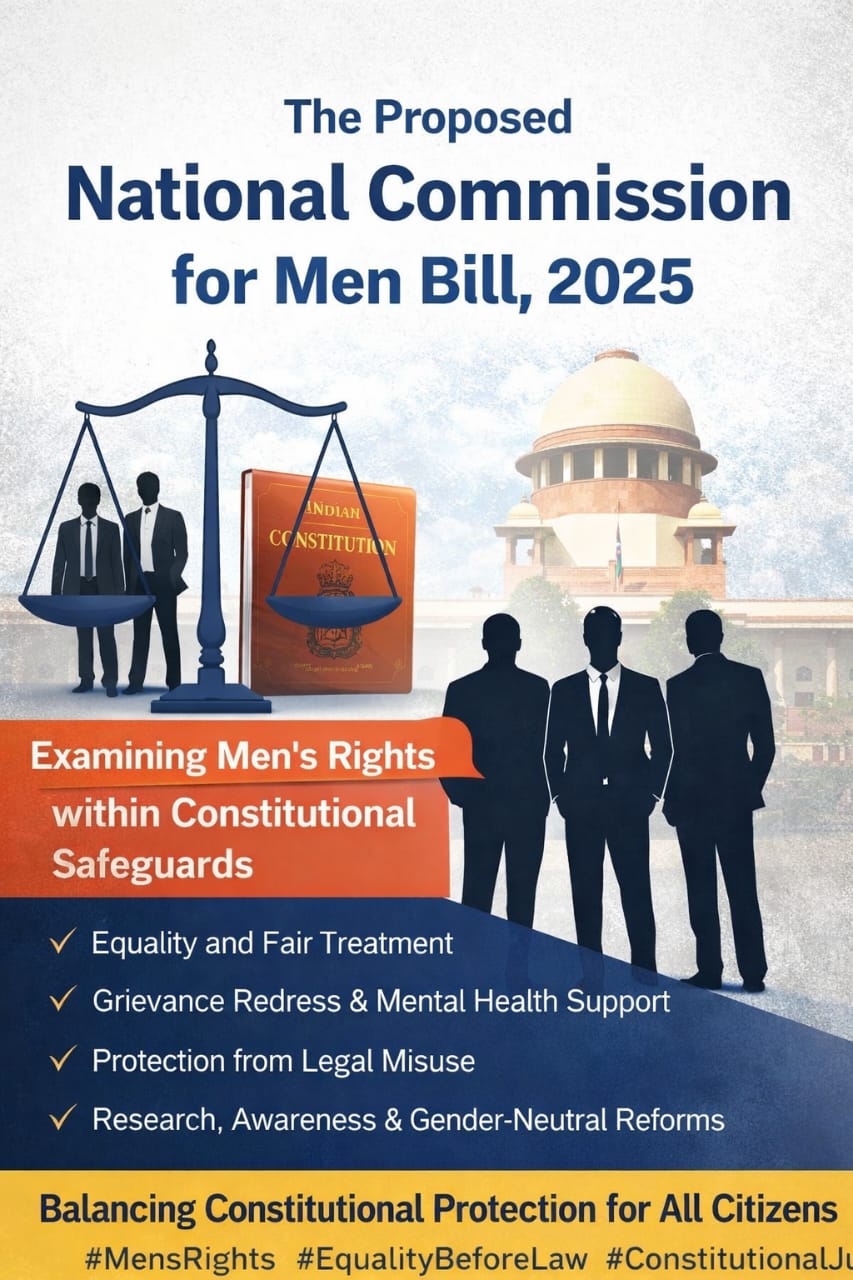
The Proposed National Commission for Men Bill, 2025
Understanding the Background, Constitutional Basis, and the Need for a Balanced Discourse
By Advocate Nazim Khan, Chandrapur
Introduction
In recent times, there has been increasing public discussion around the proposal for a National Commission for Men, often referred to as the National Commission for Men Bill, 2025. While the proposal has not yet taken the shape of enacted legislation, it has brought into focus an important constitutional question: how should the legal system respond to grievances faced by men while continuing to protect women and other vulnerable groups?
This discussion is not about opposing existing protections. Rather, it is about re-examining equality, dignity, and fairness through a constitutional lens, particularly Articles 14 and 21 of the Constitution of India, which apply equally to all citizens.
Constitutional Framework: Equality and Dignity Are Universal
- Article 14 – Equality before law and equal protection of laws
- Article 15 – Prohibition of discrimination on grounds of sex
- Article 21 – Right to life and personal liberty, including dignity and reputation
- Article 38 – Obligation of the State to promote social justice
Indian courts have consistently held that equality before law is a basic feature of the Constitution and that legal processes must be fair, proportionate, and reasonable.
Why Has the Idea of a National Commission for Men Emerged?
1. Absence of a Dedicated Institutional Forum
India has statutory commissions for women, children, minorities, and scheduled communities. However, there is no statutory body specifically mandated to study or address certain issues faced by men, including alleged misuse of law, workplace harassment complaints by men, domestic disputes, custody conflicts, and mental health concerns.
2. Judicial Observations on Fairness and Due Process
Constitutional courts have repeatedly emphasized that while protective laws are necessary, safeguards against misuse and unfair deprivation of liberty are equally vital in a rule-of-law system.
3. Social and Mental Health Concerns
Public data and academic research highlight higher suicide rates among men, low reporting of abuse, and limited counselling mechanisms, which often remain outside structured policy focus.
Conclusion
The debate around the proposed National Commission for Men reflects a broader constitutional conversation about fairness, dignity, and equality before law. A balanced legal system must protect vulnerable groups while ensuring that justice remains accessible and fair to all.
For legal queries relating to constitutional law, gender-neutral justice, and policy matters, contact Advocate Nazim Khan, Chandrapur.